Bespoke White Walk-in Closet Casework Engineering
The Art of Casework Engineering: Crafting the Ultimate Bespoke White Walk-in Closet for Modern Luxury Dressing Sanctuaries
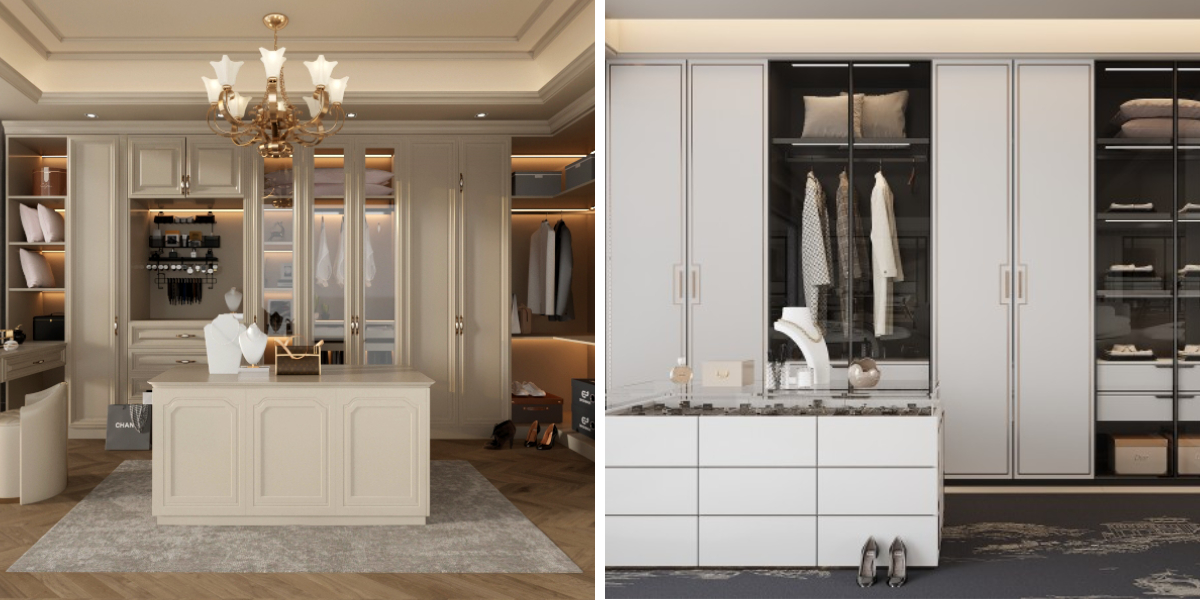
In the realm of high-end architectural millwork and premium interior layout design, the traditional closet has undergone a profound structural and conceptual evolution. No longer relegated to a mere utilitarian storage enclosure, the contemporary wardrobe is now approached as a highly sophisticated piece of structural engineering. For international architects, general commercial contractors, and luxury real estate developers, specifying a bespoke white walk-in closet system requires a deep understanding of advanced casework mechanics, precision industrial manufacturing, and uncompromising material safety standards.
Modern luxury residential portfolios, premium hospitality engineering contracts, and large-scale multi-family housing fit-outs increasingly demand integrated storage systems that harmonize minimalist aesthetics with heavy-duty structural performance. Achieving this delicate equilibrium is impossible through conventional modular carpentry. Instead, it requires a dedicated technical framework known as casework engineering—a rigorous discipline that treats premium closet configuration with the same structural scrutiny, digital precision, and spatial optimization typically applied to complex load-bearing architectural frameworks.
The Core Philosophy of Premium Casework Engineering
At its foundational level, casework engineering represents the synthesis of industrial manufacturing standardization and bespoke architectural customization. Unlike standard modular furniture assemblies, which rely on generic mass-produced layouts and loose tolerances, engineered closet casework is fabricated to satisfy specific spatial blueprints while utilizing industrialized technical joinery methods. This approach is highly critical when engineering a high-end dressing room infrastructure, where expansive configurations must maintain structural equilibrium under significant weight loads without exhibiting structural deflection, sagging, or panel misalignment over decades of continuous operation.
Micro-Tolerance Dimensional Accuracy
The defining characteristic of an engineered wardrobe system is its micro-tolerance dimensional accuracy. Utilizing digital technical shop drawings and advanced computer-aided manufacturing parameters, every vertical standard, horizontal adjustable shelf, drawer face, and back panel is machined down to sub-millimeter tolerances. In luxury installations featuring floor-to-ceiling configurations, even a minimal deviation of one millimeter across a sequence of closet towers can result in irregular gaps, binding drawer runners, and improperly aligned door fronts. Casework engineering mitigates these structural risks by applying automated machining metrics to guarantee perfect perpendicularity and parallel alignment across the entire structural installation.
Structural Load Distribution and Stress Analysis
A premium walk-in closet system must support hundreds of kilograms of garments, luggage, and luxury accessories over extended operational lifespans. Casual joinery techniques, such as standard surface-mounted screws or weak dowel configurations, inevitably fail under prolonged vertical stress. Engineered casework incorporates advanced hidden joinery methods—including heavy-duty eccentric cam-and-pin fasteners, deeply grooved structural back panels, and reinforced structural plinths. These components distribute vertical down-forces evenly across the entire structural perimeter, preventing concentrated stress points and ensuring that expansive spans remain perfectly flat and structurally sound under maximum weight capacities.
Architectural Material Selection for Luxury Environments
The visual success and long-term durability of a bespoke white walk-in closet are inherently bound to the physical and chemical characteristics of its core board composition. In the international premium market, luxury is defined not only by outer appearances but also by the hidden engineering properties of the substrate materials, their resistance to environmental factors, and their compliance with strict international environmental certifications.
Formaldehyde Emission Control and Eco-Certifications
In closed, high-end dressing room environments, indoor air quality is a non-negotiable metric for discerning clients, hospitality brands, and medical facility projects. Responsible global manufacturers implement strict environmental controls by sourcing raw materials that comply with the world's most rigid sustainable protocols, including E0, ENF, and FSC certifications.
The ENF (Essential Non-Formaldehyde) standard represents the pinnacle of ecological board engineering, requiring formaldehyde emissions to remain below or equal to $0.025 \text{ mg/m}^3$. By utilizing advanced MDI (Methylene Diphenyl Diisocyanate) polyurethane eco-resins instead of conventional urea-formaldehyde glues, the core panels emit virtually zero volatile organic compounds (VOCs). This ensures that large-scale interior casework installations remain completely safe for residential, hospitality, and specialized healthcare engineering applications.
Advanced Substrate Engineering: Particle Board vs. MDF
Selecting the appropriate engineered substrate depends heavily on the specific mechanical application of each closet element:
High-Density Engineered Particle Board: Utilized primarily for primary structural carcases, vertical standards, and heavy-duty shelving units. This substrate features a multi-layered density gradient, with larger wood particles in the core for exceptional screw-holding capacity and tensile strength, bounded by ultra-fine exterior layers for smooth surface application. Its cross-laminated internal fiber structure minimizes directional warping and ensures long-term dimensional stability under varying humidity levels.
Medium-Density Fiberboard (MDF): Reserved for premium profiled drawer fronts, architectural door panels, and elements requiring complex CNC routing or high-gloss lacquering. MDF offers a completely homogeneous density profile, allowing for sharp, precise edge profiles and an ultra-smooth face finish free of grain telegraphing.
Non-Yellowing Core Finishes and Textured Material Matrix
The primary challenge of executing a minimalist white wardrobe aesthetic is preventing surface degradation and yellowing caused by UV exposure, ambient heat, and chemical oxidation. Premium casework utilizes advanced decorative overlays, such as multi-layered premium melamine films or electron-beam cured (EBC) acrylic surface layers. These high-performance finishes are engineered with integrated UV-inhibitors that preserve a pristine, crisp white appearance indefinitely.
To provide depth and tactile variation within modern dressing sanctuaries, designers frequently interweave a balanced material matrix. This includes integrating sophisticated monochromatic shades like light grey or charcoal, alongside highly realistic, textured wood-grain patterns and custom wood-tone veneers. This dual-material strategy allows developers to implement striking aesthetic contrasts while remaining fully compliant with accurate Google indexing and transparent project documentation by avoiding misleading designations like solid wood.
Advanced Manufacturing Technology and Industrial Scale
Translating complex architectural shop drawings into physical, high-precision closet components requires a substantial capital investment in automated industrial manufacturing infrastructure. High-end B2B project fulfillment cannot be achieved through manual workshop methods; it demands a seamless, end-to-end digital factory layout where human error is completely designed out of the production cycle.
The Power of Standardized Workshops
Operating out of a modern, standardized production facility covering over 6,000 square meters, established operations like MG Home leverage advanced industrial scale to execute massive multi-unit contracts with flawless consistency. Established in 2019, these manufacturing facilities are built around a continuous-flow production matrix. Raw boards enter at one terminal and emerge as fully machined, flat-packed, installation-ready casework components at the other, ensuring short lead times and uniform quality control across orders spanning hundreds of custom wardrobe units.
Top-Tier Intelligent Production Lines
The backbone of this industrial efficiency is the implementation of top-tier domestic intelligent production lines, which rival global systems in precision and output. These highly automated systems seamlessly connect design software directly to the factory floor:
Automated CNC Nesting Centers: Computer algorithms automatically optimize the cutting layout on each raw sheet to minimize material waste while executing high-speed nesting, drilling, and routing simultaneously with millimeter precision.
Laser Edge-Banding Technology: Rather than using conventional hot-melt glues that leave visible dark seam lines and are susceptible to moisture intrusion, advanced intelligent production lines utilize laser or hot-air fusion technology. A high-energy laser melts a co-extruded functional layer on the edge band, fusing it directly to the board fiber. This creates a zero-joint, virtually seamless edge that is entirely waterproof, visually immaculate, and resistant to delamination under extreme climate variations.
Intelligent Internal Layout Configuration & Space Optimization
An engineered bespoke white walk-in closet is fundamentally an exercise in ergonomic efficiency and geometric optimization. The internal architecture of the casework must be systematically zoned to accommodate different types of apparel, accessories, and personal items, maximizing storage volume while ensuring an intuitive, elegant user experience.
Ergonomic Casework Zoning and Layout Principles
Professional casework designers divide the vertical plane of the wardrobe into three distinct ergonomic accessibility zones:
Primary Access Zone (700mm – 1800mm): Positioned at eye and hand level, this zone is allocated for daily-wear items. It incorporates short-hanging rods for shirts and blazers, open shelving for folded premium knitwear, and primary drawer banks.
Lower Access Zone (Floor to 700mm): Dedicated to specialized footwear displays, heavy pull-out laundry hampers, and deeper storage drawers for bulkier apparel items.
Upper Overhead Zone (1800mm to Ceiling): Reserved for seasonal garments, travel luggage, and infrequently used bedding items.
Specialized Internal Storage Additions
To elevate the utility of a luxury dressing room, engineered wardrobe layouts move beyond basic shelving by incorporating specialized high-density pull-out storage accessories:
Integrated Velvet Jewelry Trays: Soft-closing, slim-profile drawer systems lined with anti-tarnish premium velvet, complete with customized compartments for luxury watches, rings, and fine jewelry pieces.
Pull-Out Trouser and Belt Organizers: Lateral non-slip racks that allow trousers to hang crease-free, sliding out smoothly on full-extension runners for effortless selection.
Dedicated Shoe Display Casework: Angled shelving units with integrated front lips, often backed by tinted mirrors or leather upholstery, designed to showcase luxury footwear collections under optimized viewing angles.
Comprehensive B2B Technical Service and Global Supply Chain Execution
For international commercial buyers, purchasing custom casework globally involves managing significant logistics, engineering, and quality control risks. A reliable production partner must offer comprehensive technical services that bridge the gap between initial architectural concepts and final on-site installation.
In-House Architectural Layout and Shop Drawing Verification
The B2B execution workflow begins with a comprehensive review of the project blueprints submitted by the client's engineering or interior design team. An experienced in-house technical design team evaluates the architectural layout, checking for potential structural conflicts, plumbing or electrical obstructions, and accurate site dimensions. This layout data is then translated into highly detailed 3D CAD shop drawings, which define every panel thickness, hardware boring location, and joint detail, ensuring complete transparency and alignment before manufacturing begins.
Rigid Factory Pre-Assembly and Quality Audits
Before any project is approved for international shipping, the factory management team conducts a strict pre-assembly quality audit. Representative modules from the custom wardrobe batch are fully assembled on the factory floor. Experienced QA inspectors meticulously check:
Perfect squareness and parallel tracking of all cabinet carcases.
The smooth, synchronized gliding movement of all concealed drawer runners.
Uniform perimeter gaps and accurate soft-closing performance.
Full compliance with the specified E0/ENF environmental formaldehyde metrics.
Sea-Freight-Safe Flat Packaging Protocols
Long-distance ocean transport requires robust packaging architecture to ensure products arrive in immaculate condition. Engineered flat-pack packaging protocols incorporate multiple layers of protective materials:
Surface Wrap: Every finished panel face is wrapped in anti-scratch protective film to shield it from friction.
Edge Protection: High-density EPE foam corner protectors cushion all perimeter edges against severe impacts.
Rigid Outer Enclosure: The components are packed within heavy-duty, double-wall corrugated export cartons, which are then securely strapped onto reinforced, IPPC-certified ISPM-15 fumigated wooden pallets to facilitate safe forklift handling and container loading operations.
Frequently Asked Questions (FAQ) for Commercial B2B Buyers
Q1: How does your factory ensure absolute color consistency and prevent long-term yellowing across a large-scale white wardrobe project?
A: We use high-performance, non-yellowing surface coatings and multi-layered decorative films that feature integrated ultraviolet (UV) inhibitors. Our materials undergo rigorous accelerated weather testing under concentrated UV exposure to ensure zero shade shifts over long operational lifespans. Additionally, our top-tier intelligent production lines utilize automated color-matching sensors to guarantee absolute color consistency across multiple production batches, which is a critical requirement for multi-unit apartment and hospitality developments.
Q2: What is the standard lead time for a high-volume multi-family residential or hospital engineering casework contract?
A: Our standard production lead time typically ranges from 30 to 45 days upon formal technical sign-off of the 3D CAD shop drawings and receipt of the initial deposit. Operating a specialized 6,000+ square meter standardized workshop equipped with high-speed automated CNC nesting and laser edge-banding lines enables us to maintain a predictable, reliable production capacity. This allows us to scale production efficiently to meet demanding architectural schedules without compromising structural quality or micro-tolerance precision.
Q3: Can your in-house design team work directly from preliminary architectural blueprints, and do you provide on-site engineering support?
A: Yes, our in-house engineering team routinely collaborates directly with international architects, general contractors, and project managers to convert preliminary BIM models, architectural layouts, or hand-measured dimensions into detailed, factory-ready shop drawings. For large-scale commercial contracts or premium villa developments across key global regions, we can also deploy senior technical representatives to provide precise on-site measurement services and comprehensive installation guidance to your engineering contractors.
Secure Your Project Evaluation Matrix Today
Are you an international architect, multi-family residential developer, or general commercial contractor managing an upcoming high-end interior development? Don't leave your project's millwork execution to chance. Partner with a verified industrial leader specializing in high-capacity casework engineering, pristine aesthetics, and certified eco-friendly sustainability.
Contact our dedicated Export Sales Engineering Department today to receive:
A comprehensive technical layout review of your architectural blueprints.
Complimentary 3D CAD shop drawing consultations and custom volume pricing matrices.
Certified material sample kits, including E0/ENF-grade white panels, wood-grain finish swatches, and premium functional hardware catalogs from Blum and Hafele.
📥 [Request an Engineering Consultation & Custom B2B Quote Now]