How Automated CNC Manufacturing Guarantees Precision in Modern Custom Cabinets
Discover how automated CNC manufacturing delivers industrial-grade precision, zero-error tolerance, and seamless execution for custom cabinets in B2B projects.
Executive Summary: The Industrial Evolution of Architectural Joinery
The global commercial and high-end residential construction sectors are undergoing a profound structural shift. As architectural blueprints grow increasingly intricate and project delivery timelines tighten, traditional manual woodworking methods can no longer fulfill the stringent dimensional tolerances, structural consistency, and volume throughput required by international property developers, general contractors, and commercial design firms.
In response to these evolving market dynamics, advanced B2B cabinet manufacturing facilities have transitioned from craftsman-dependent workshops to fully automated, digitally integrated production ecosystems. At the core of this industrial modernizing is Computer Numerical Control (CNC) machinery. The deployment of automated CNC technology has fundamentally re-engineered how high-grade custom cabinets are engineered, fabricated, and assembled.
This report examines the technological mechanisms through which automated CNC manufacturing eliminates human error, guarantees sub-millimeter precision, maximizes material yields, and streamlines large-scale project execution—ensuring total compliance with complex architectural joinery specifications.
The Precision Dilemma: Manual Craftsmanship vs. Automated CNC Execution
Historically, interior joinery relied heavily on manual measuring, panel cutting, edge profiling, and hand-drilling. While skilled artisanal techniques hold legacy value, manual execution introduces compound error accumulation—a critical flaw when executing multi-story residential developments or boutique commercial projects.
When producing bespoke cabinetry across dozens or hundreds of unit layouts, minor variance—such as a 1.5mm deviation in panel squareness—cascades into misaligned carcass frames, uneven door reveals, binding drawer slides, and extended job-site installation delays.
Automated CNC processing resolves this structural vulnerability by substituting physical measurement tools with digital data streams derived directly from modern Computer-Aided Design (CAD) and Computer-Aided Manufacturing (CAM) software platforms.
Key Manufacturing Metrics Comparison
Dimensional Precision: Manual joinery methods maintain ± 1.5 mm – 3.0 mm, whereas Automated CNC Manufacturing Systems achieve sub-millimeter accuracy of ± 0.1 mm.
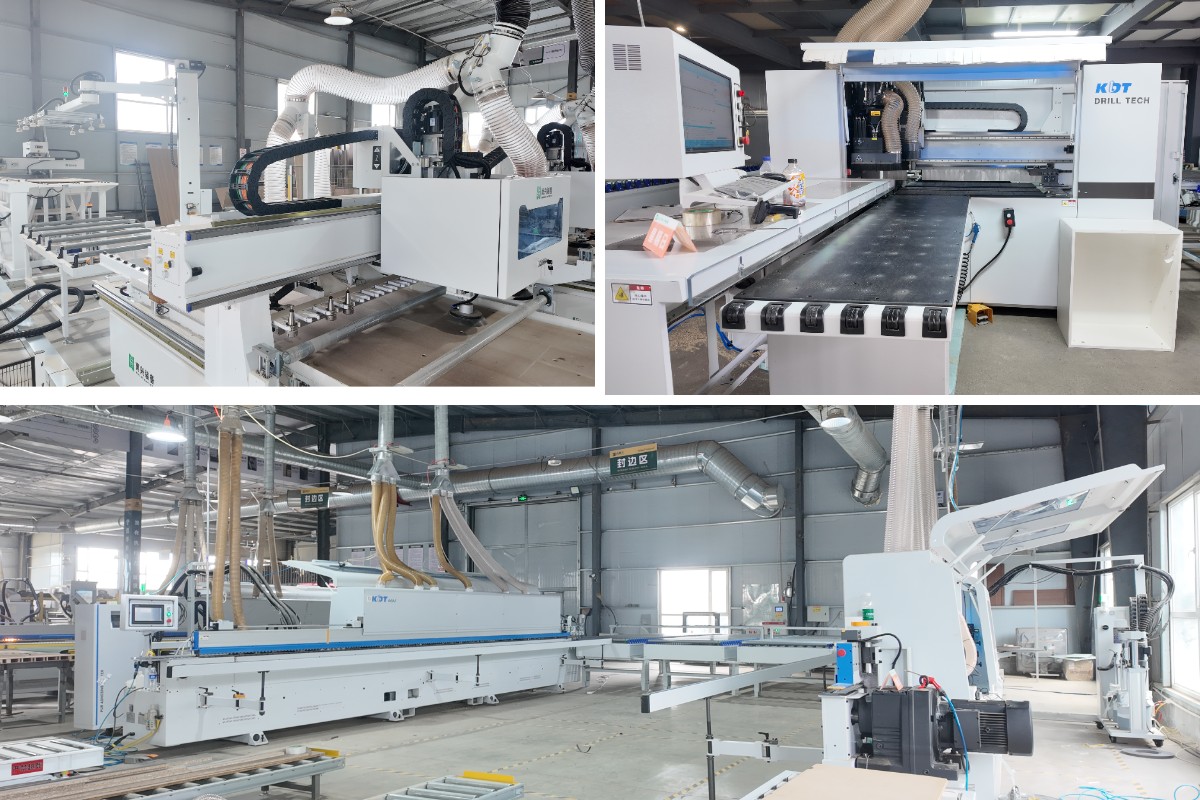
Edge Banding Adhesion Integrity: Manual processes exhibit variable quality from hand-applied hot-melt glues, while automated systems utilize German Jowat PUR zero-joint hot-melt sealing for permanent moisture isolation.
Multi-Axis Hole Processing Speed: Manual drilling relies on sequential single-hole operations, whereas multi-axis CNC drilling centers execute simultaneous 6-sided drilling in a single pass.
Yield and Material Utilization: Manual panel layouts generate 70% – 80% material utilization, while algorithmic CNC nesting maximizes yield rates to 92% – 96%.
Through algorithmic tooling protocols, automated production guarantees that every substrate panel processed maintains uniform structural integrity and dimensional consistency regardless of production scale.
1. Algorithmic Material Yields: High-Precision CNC Nesting Technology
The fabrication process begins with raw panel processing, where industrial-grade CNC nesting machines transform engineering parameters into physically optimized components.
Algorithmic Panel Layout Optimization
In conventional manufacturing, panel cutting is restricted by linear saw movements, forcing cut patterns into rigid grids that result in significant material waste. Modern industrial nesting platforms utilize advanced optimization algorithms that evaluate the dimensional geometry of every individual cabinet component required across an entire order.
The algorithm dynamically arranges rectangular panels, curved profiles, and irregular shapes onto standard sheet sizes (such as high-density MDF or marine-grade plywood) to achieve material efficiency rates exceeding 92% to 96%.
1.CAD Drawing Import: Translates vector geometry into exact machine coordinates.
2.Dynamic Rotation: Rotates components dynamically to align with natural wood grain patterns.
3.Kerf Loss Calculus: Calculates precise tool bit diameter clearance to eliminate cutting overlap.
4.Toolpath Routing: Generates multi-pass high-speed cutting paths for clean, burr-free panel edges.
High-Speed Spindle Stability and Vacuum Hold-Down Solutions
Precision cutting requires absolute mechanical stability during high-speed spindle operations. Industrial nesting centers employ multi-zone vacuum suction beds capable of generating intense holding pressure across the substrate.
Zone-Controlled Vacuum Beds: Concentrates suction power strictly beneath the active cutting area, preventing micro-vibrations or panel shifting even when milling intricate, small-format cabinet components.
Electro-Spindle Precision: High-frequency air-cooled or liquid-cooled spindles running at up to 24,000 RPM eliminate raw material chipping, tearing, or edge delamination along delicate surface veneers or high-gloss lacquers.
By eliminating human panel handling during primary milling, nesting technology guarantees that the foundational panel dimensions for all custom cabinets remain completely true to approved CAD shop drawings.
2. Environmental Resilience: Automatic Edge-Banding Machines and Moisture Isolation
A cabinet's structural longevity is largely governed by the quality of its edge protection. In kitchen, bathroom, and commercial hospitality environments, moisture penetration represents the leading cause of core substrate swelling, mold formation, and premature structural failure.
Automated manufacturing addresses this operational vulnerability through industrial automatic edge-banding machines utilizing advanced adhesive chemistry and continuous feed automation.
German Jowat PUR Hot-Melt Adhesive Systems vs. Traditional EVA Adhesives
Traditional factories rely heavily on standard Ethylene Vinyl Acetate (EVA) hot-melt glues, which are susceptible to thermal reactivation and moisture degradation over time. Advanced automated lines integrate German Jowat PUR Hot-Melt Adhesives, establishing a world-class standard for industrial edge bonding:
1.Chemical Cross-Linking: Jowat PUR adhesives undergo an irreversible chemical reaction with atmospheric moisture upon application, forming a permanent high-strength bond that withstands severe ambient temperature fluctuations and continuous humidity exposure.
2.Ultra-Thin Glue Lines: Automated dispensing systems maintain precise glue thickness control with Jowat PUR, producing "zero-joint" edge aesthetics where the glue line becomes visually invisible to the naked eye while achieving 100% waterproof edge seals.
Integrated Trimming and Finishing Station Sequence
Industrial edge banders execute a continuous multi-stage finishing sequence at line speeds of up to 20 to 30 meters per minute:
Pre-Milling Unit: Uses diamond cutter heads to shear off 0.5mm to 1.0mm of the raw panel edge, eliminating saw micro-fractures and creating a pristine surface for adhesive bonding.
Pressure Roller Zone: Applies calibrated pneumatic pressure to force the edging tape into the substrate core.
End-Trimming and Corner Rounding: High-precision servo motors trim excess tape flush with the front and rear panel edges, smoothly rounding corner junctions without leaving sharp arrises or manual cutter marks.
Scraping and Buffing: Dual-blade pneumatic scrapers remove microscopic glue squeeze-out, followed by motorized cloth buffing wheels that restore the original sheen of the edge banding material.
This automated sealing process insulates internal core materials, ensuring long-term durability and structural integrity in demanding environments.
3. High-Speed Structural Assembly: Six-Sided Drilling Machines
Once panels are nested, cut, and edge-banded, they proceed to hardware preparation. Modern cabinet construction relies heavily on hidden mechanical fasteners, cam locks, wooden dowels, concealed hinges, and undermount drawer slides. The exact placement of these mounting positions governs how effortlessly the cabinet carcass assembles on the job site.
The introduction of CNC six-sided drilling machines has fundamentally transformed this phase of production.
Simultaneous Multi-Axis Machining
Conventional drilling machines required manual panel flipping and multiple pass setups to bore holes on top, bottom, and side faces. Each repositioning introduced human placement error.
High-efficiency 6-sided CNC drilling centers execute all drilling, routing, and grooving operations across all six spatial planes of a panel in a single automated pass:
Dual-Gantry Drive Architecture: Upper and lower drilling heads operate simultaneously, boring through-holes and blind holes from both sides without panel flipping.
Integrated Grooving Saws: Independent saw units cut continuous channels for carcass back-panels simultaneously with dowel and hinge boring.
Optical and Laser Sensor Alignment: Non-contact optical sensors measure the leading and trailing edges of each incoming panel in real time, dynamically adjusting drilling coordinates to compensate for micro-scale board length variances.
Hardware Compatibility and Structural Reliability
Because hardware mounting patterns are driven directly by CAD component files, drilling centers generate perfectly aligned holes for global hardware standards, including DTC, Blum, Hettich, and Hafele systems.
This exact positioning eliminates the need for manual adjustment during assembly, ensuring that hinges swing smoothly, drawer runners align without friction, and cabinet frames assemble square and rigid every time.
4. Sustainability and Compliance: E0 Grade Furniture Manufacturing
Modern architectural specifications demand strict compliance with international indoor air quality (IAQ) and chemical emission standards. The integration of automated CNC machinery plays a direct role in maintaining environmental compliance, specifically supporting E0 grade furniture manufacturing guidelines.
International Formaldehyde Emission Standards
European E1 Standard: Allowable formaldehyde limit ≤ 0.124 mg/m³ air (0.1 ppm).
European E0 Standard: Allowable formaldehyde limit ≤ 0.050 mg/m³ air.
CARB Phase 2 / EPA TSCA Title VI: Allowable formaldehyde limit ≤ 0.050 ppm for MDF and Plywood substrates.
ENF Standard (Ultra-Low Emission): Allowable formaldehyde limit ≤ 0.025 mg/m³ air.
Industrial automated manufacturing lines preserve substrate compliance through engineered process controls:
Dust Extraction and Air Quality Control
Substrate materials certified to E0, CARB Phase 2, or EPA TSCA Title VI standards require clean, dust-free processing environments to maintain surface integrity and adhesive performance. Automated CNC machining centers incorporate centralized, closed-loop dust extraction systems operating with high capture velocity:
High-Vacuum Enclosures: Captures airborne wood dust directly at the cutter spindle, preventing dust accumulation within panel joinery channels and surface laminates.
Material Integrity Preservation: Prevents microscopic dust particulate contamination between the substrate surface and edge-banding adhesives, securing the air-tight seal required to lock potential trace emissions inside board cores.
Waste Reduction and Resource Optimization
By maximizing panel yield via computerized nesting algorithms, automated CNC manufacturing drastically reduces timber waste generation per cabinet unit. Efficient material utilization directly supports sustainable architectural practices and green building certification frameworks, such as LEED (Leadership in Energy and Environmental Design) and BREEAM.
5. B2B Project Delivery: Streamlining Job-Site Execution
For global project developers and main contractors, the financial success of a project depends heavily on job-site installation efficiency. Off-site pre-machining and automated fabrication shift critical manufacturing labor from uncontrolled job-site conditions into a controlled factory environment.
Pre-Machined Plug-and-Play Assembly
By completing all cutting, edge sealing, and hardware drilling with CNC precision, cabinet components function as modular, interlocking building blocks:
1.Elimination of Field Cutting: Installation crews no longer need to trim, plane, or drill cabinet carcasses on-site, significantly reducing site dust, noise pollution, and installation labor costs.
2.Error-Free Component Identification: Automated CNC processing lines print barcode labels directly onto every panel component. Installers simply scan barcodes to view assembly sequences, hardware requirements, and floor-plan placement data.
3.Rapid Project Handover: Reduced assembly time enables contractors to meet tight project handovers while maintaining consistent joinery quality across hundreds of residential or commercial units.
Technical Conclusion: The Future of Precision Joinery
Automated CNC manufacturing is no longer merely an operational upgrade; it is an essential foundation for high-performance architectural joinery. By integrating automated CNC nesting, high-speed edge banding, 6-sided multi-axis drilling, and sustainable substrate processing, modern production facilities guarantee that every cabinet panel meets exact structural and aesthetic standards.
For international buyers, architects, and project managers, specifying automated manufacturing protocols ensures total design fidelity, long-term durability, and seamless job-site installation across demanding interior projects.
B2B Architectural Procurement Checklist
When evaluating manufacturing partners for large-scale interior joinery projects, verify that the supplier maintains the following technological capabilities:
CNC Nesting Integration: Automated CAD/CAM software workflow with dynamic material yield optimization.
German Jowat PUR Edge-Banding Machinery: Zero-joint hot-melt glue application with pre-milling and corner-rounding capabilities.
6-Sided Drilling Capacity: Simultaneous multi-axis drilling for hardware placement accuracy.
Certified E0/CARB Substrates: Fully compliant low-formaldehyde board inventory with mill certification tracking.
Factory Pre-Assembly Verification: Full 1:1 scale mock-up testing and dimensional inspection protocols prior to export packaging.