Streamlining Residential Projects with OEM/ODM Cabinets
Discover how scalable OEM/ODM custom cabinet manufacturing streamlines large-scale residential developments through engineering, QA, and global logistics.
The Evolving Landscape of Multi-Family Residential Procurement
Global residential development is undergoing a fundamental structural shift. As real estate developers, general contractors, and architectural firms navigate tightening construction schedules, fluctuating material costs, and increasingly complex local building codes, traditional procurement frameworks are proving inadequate. In multi-family housing complexes, high-rise residential towers, and suburban master-planned communities, the procurement of interior joinery—specifically kitchen, bathroom, and storage systems—presents one of the most persistent bottlenecks in project execution.
Historically, field-constructed joinery and fragmented sourcing models dominated the residential build sector. However, site-built millwork introduces significant operational risks: inconsistent dimensioning across repeated layouts, unpredictable field labor overhead, extended site installation timelines, and decentralized quality management. To mitigate these execution risks, modern project management frameworks increasingly rely on off-site industrialized manufacturing.
Integrated industrial production shifts precision joinery from field craftsmanship to automated factory environments. By centralizing engineering, material processing, edge banding, and pre-assembly testing within controlled manufacturing facilities, developers establish predictable critical-path milestones. Within this industrialized ecosystem, whole-house cabinets serve as a critical operational bridge between architectural design intent and physical structural completion, transforming custom interior layouts into repeatable, scalable component systems.
Defining Full-Scope OEM/ODM Manufacturing Partnerships
Understanding the precise technical operational scope of Original Equipment Manufacturing (OEM) and Original Design Manufacturing (ODM) is essential for commercial procurement managers structuring high-volume purchase agreements. While these terms are frequently conflated, they represent distinct technical touchpoints within the product development cycle.
OEM Execution Framework
Under a pure OEM partnership, the developer, project architect, or interior design firm supplies complete Architectural Millwork Drawing Sets, Material Take-Off (MTO) schedules, hardware specification matrices, and finishing requirements. The manufacturer operates as an advanced technical production engine, executing precise digital nested CNC machining, edge profiling, drilling, and finishing according to strict client-provided technical packages. The primary benchmark of OEM success is total fidelity to client drawings and tolerance adherence.
ODM Engineering Solutions
Conversely, an ODM model engages the manufacturer much earlier in the schematic design and design development phases. When real estate developers encounter budgetary constraints, supply chain bottlenecks, or value-engineering mandates, the manufacturer’s internal Research & Development (R&D) and engineering teams intervene. The manufacturer adapts raw design concepts into production-ready millwork packages, optimizing panel utilization, recommending structural joinery methods, and establishing standardized hardware mounting grids to balance aesthetic intent with cost efficiency.
Phase | OEM Scope | ODM Scope |
Schematic Design | Client Provided | Joint Engineering |
Technical Drafting | Client Provided | Manufacturer Led |
Prototyping & DFM | Verification Only | Full DFM Optimization |
Automated Production | Full Execution | Full Execution |
Partnering with an end-to-end industrial manufacturer combining both OEM and ODM capacities provides large-scale developers with an agile operational ecosystem. Single-source responsibility eliminates miscommunications between third-party design agencies and manufacturing facilities, preventing costly field retrofits and project delays.
Engineering Precision and Material Standardizations
Large-scale multi-family developments require strict material standardizations to guarantee structural integrity, long-term durability, environmental compliance, and fire safety across hundreds of identical or mirrored residential units. High-performing OEM/ODM manufacturing facilities operate strictly within certified international quality management structures, utilizing fully trace-tested raw materials.
Substrate Selection and Performance Characteristics
Substrate selection forms the foundational integrity of long-term interior joinery. Depending on regional climate variations, humidity conditions, and specific residential functional zones, engineering teams specify tailored core panel boards:
Plywood (Exterior-Grade Birch/Poplar): High moisture resistance and superior screw-holding power. Features multi-ply cross-laminated timber core boards bound with moisture-resistant resins. Specified for high-load application structures, vanity carcasses subject to ambient humidity, and high-end residential kitchen box construction with natural veneer or paint finishes.
Medium-Density Fiberboard (MDF): Moderate moisture resistance and steady screw-holding power. Homogeneous wood fiber core offering exceptional dimensional stability, uniform density, and smooth surface characteristics. Serves as the primary substrate for intricate CNC 3D routing, shaker-style door profiles, and high-gloss, matte polyurethane lacquer, or PVC finishes.
Particle Board (Chipboard / MFC): Standard moisture resistance and structural screw-holding capacity. High-density thermo-pressed wood chip cores faced with melamine resin-impregnated decorative paper. Provides an economical, structurally sound solution for internal shelving, structural carcases, and dry-zone residential wardrobes.
Formaldehyde Emission and Environmental Certifications
International residential real estate markets require strict compliance with indoor air quality regulations. Industrial export manufacturers implement automated panel testing to satisfy rigorous global environmental standards:
CARB Phase 2 / EPA TSCA Title VI: Mandatory ultra-low formaldehyde emission standards governing composite wood products imported into North America.
European E1 and E0 Standards: EN 717-1 chamber test compliance ensuring airborne emissions remain strictly below regulatory thresholds for indoor environments.
FSC (Forest Stewardship Council) Certification: Complete Chain of Custody (CoC) verification guaranteeing timber substrates originate from responsibly managed, sustainable forestry operations.
Precision Hardware Integration
The operational lifespan of residential millwork is governed by functional hardware integration. Full-scope manufacturers partner directly with top-tier global hardware manufacturers—including Blum, Hettich, Hafele, DTC, and Tutti—to integrate heavy-duty concealed hinges, full-extension soft-close drawer slides, gas struts, and lift-up stay systems. Standardized 32mm system drilling matrices ensure exact mechanical mounting, preventing sag, hardware misalignment, or premature mechanical failure over thousands of operational cycles.
The Industrialized Manufacturing Process: From CAD to Container
Modern industrialized joinery manufacturing relies on integrated digital workflows connecting architectural drawings directly to the factory floor. By removing manual measurement transcription and physical template cutting, automated production lines achieve dimensional tolerances within ±0.2mm across high-volume production runs.
The automated workflow operates seamlessly across five core stages:
1.Parametric CAD/CAM Engineering: Architectural CAD drawings and Building Information Modeling (BIM) files are converted into machine-readable G-code via parametric CAM software. The software automatically extracts production schedules, generates cutting lists, creates hardware drilling profiles, and applies automated panel nesting algorithms. Material yield optimization routinely exceeds 92%, minimizing raw panel waste and reducing project costs.
2.Automated CNC Nesting and Panel Sizing: Automated panel saws and heavy-duty CNC nesting routers process raw composite sheets according to digital cutting patterns. High-speed, vacuum-table CNC routers perform panel sizing, sink cutouts, cable pass-throughs, and structural dado joints simultaneously, applying individual barcode labels to every cut component for real-time tracking throughout the factory floor.
3.Industrial Edge Banding Technology: Exposed panel edges are sealed utilizing high-performance industrial edge banding machinery. Depending on project specifications and moisture-resistance mandates, factories utilize standard EVA hot-melt adhesives, high-performance waterproof PUR (Polyurethane) adhesives for moisture-prone zones, or laser zero-joint edge banding for completely seamless transitions without gluelines.
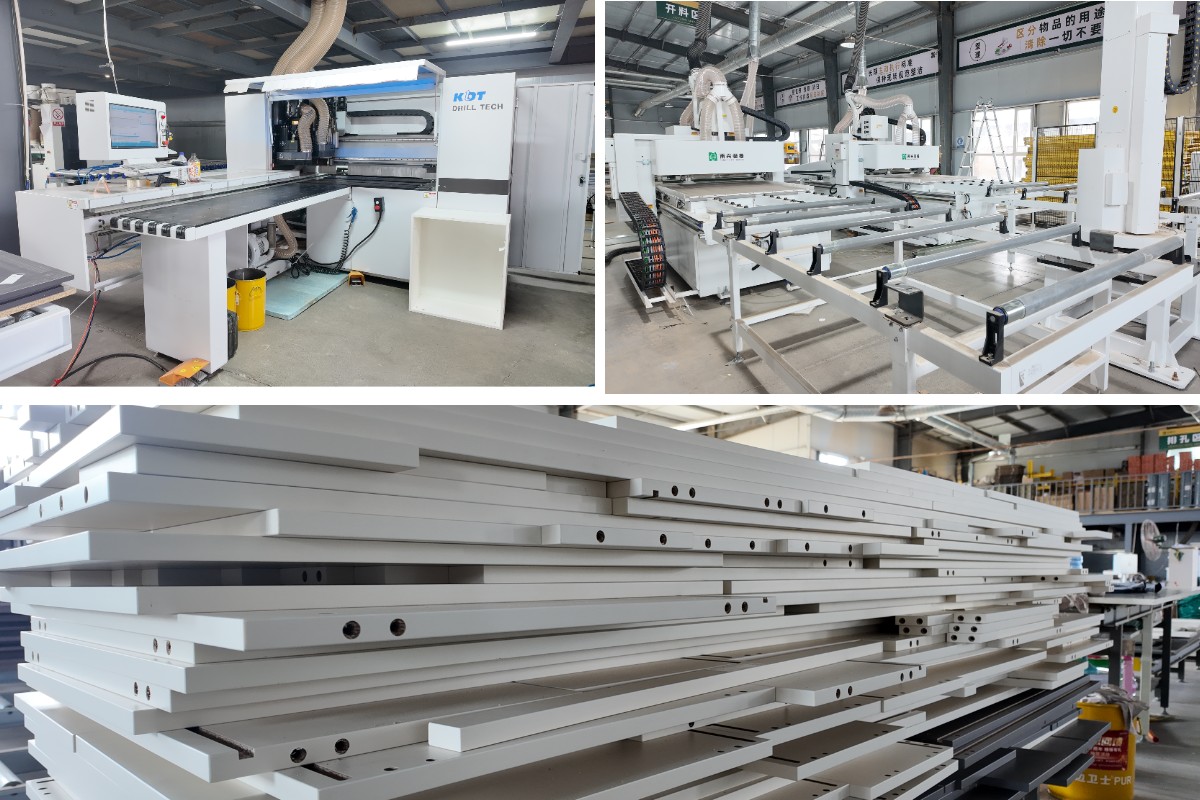
4.Six-Sided CNC Boring and Drilling: After edge processing, panels move to high-speed six-sided drilling machines. Optical sensors read component barcodes, instantly loading individual machining programs. The machine executes top, bottom, and side drilling for dowels, cam locks, shelf supports, and hinge mounting plates in a single automated pass without manual panel re-positioning.
5.Automated Board Washing and Surface Cleaning: Prior to final quality inspection and packaging, processed panels pass through automated board cleaning and brush-washing machines. High-pressure air jets and anti-static rotary brushes remove wood dust, adhesive residue, and micro-particles from panel surfaces and drilled boreholes, preventing surface abrasion during transit.
Quality Assurance, Mock-Up Protocols, and On-Site Fit-Out Optimization
In high-volume B2B manufacturing, quality control must function as a proactive, continuous engineering discipline rather than a passive final inspection. Implementing rigorous verification phases throughout production prevents systemic site errors across multi-hundred-unit orders.
A comprehensive three-tier inspection protocol is applied across all manufacturing phases:
Stage 1: IQC (Incoming Quality Control): Substrate density and core moisture testing, surface veneer/melamine thickness measurement, and formaldehyde emission certification verification.
Stage 2: IPQC (In-Process Quality Control): Dimensional tolerance checks adhering to a strict ±0.2mm benchmark, edge banding peel strength and glueline inspection, and real-time barcode tracking verification across CNC stations.
Stage 3: OQC (Out-Going Quality Control): Full 1:1 pre-assembly mock-up inspection, hardware operational cycle testing, alignment verification, and heavy-duty export packaging drop testing.
1:1 Factory Mock-Up Inspection
Before mass production authorization, reputable OEM/ODM partners mandate a 1:1 physical factory mock-up phase. Complete room configurations—including kitchen runs, bathroom vanities, and built-in wardrobes—are fully assembled on factory test floors. Client representatives, general contractors, or third-party inspection agents (such as SGS, TÜV, or Intertek) evaluate:
Dimensional alignment against architectural elevation drawings.
Door and drawer reveal consistency (standardized 2mm or 3mm reveals).
Structural load capacity of wall-hanging bracket systems.
Hardware smooth movement, soft-close dampening rate, and mechanical adjustment range.
Packaging Engineering and Logistics Protection
Damage during international ocean transport or site handling neutralizes off-site manufacturing efficiencies. Export joinery requires specialized protective packaging solutions:
Flat-Pack (KD - Knocked Down): Maximizes container loading volume, dramatically reducing international freight costs per unit. High-density corner protectors, EPE foam sheets between finished surfaces, heavy-duty 5-ply corrugated outer cartons, and plastic strapping protect components during transit. Includes standardized assembly manuals and hardware pack coding.
Rigid / Pre-Assembled Packaging: Cabinets are shipped fully assembled from the factory floor. Preferred for fast-track high-rise developments where local field labor costs are prohibitively high, allowing direct placement from shipping container to residential unit.
Comparative Advantage: Tailored Solutions for Project Typologies
Distinct real estate assets require tailored engineering approaches to balance initial capital expenditures against long-term property performance:
Luxury Multi-Family Residential Towers: Built on Birch Plywood or MDF substrates paired with natural wood veneer or UV finishes. Designed for luxury condominium developments demanding high-end finishes, complex architectural detail, and premium functionality. Production lines utilize real wood veneer matching across adjacent door fronts, ultra-matte anti-fingerprint lacquer surfaces, and integrated LED channels. Precision custom interior wall panels are engineered in matching wood grains to establish seamless visual continuity.
Student Housing & Affordable Housing: Built on high-density MFC substrates paired with impact-resistant thermofoil or PVC finishes. Optimized for maximum panel utilization, rapid field assembly, and cost-efficiency. Heavy-duty melamine-faced chipboard with durable ABS edge banding provides scratch resistance, color consistency across thousands of units, and easy long-term maintenance.
Hospitality & Extended-Stay Suites: Built on MDF or marine-grade plywood substrates paired with polyurethane lacquer or high-pressure laminate finishes. Commercial hospitality spaces require heavy-duty impact resistance and continuous moisture protection. Engineering specifications integrate marine plywood, PUR edge banding, HPL, and 304 stainless steel sink base linings to withstand heavy daily use.
Commercial Offices: Built on E0 grade MFC substrates paired with melamine or high-pressure laminate (HPL) finishes, providing durable, low-emission storage solutions for executive offices, conference rooms, and corporate breakrooms.
Frequently Asked Questions (FAQ)
What are the standard lead times for high-volume residential OEM/ODM orders?
Standard production lead times for large-scale B2B orders typically range from 35 to 50 calendar days following technical shop drawing approval, material selection sign-off, and deposit confirmation. Initial design development, DFM engineering, and 1:1 factory mock-up prototyping generally require an additional 15 to 20 days prior to mass production release.
How do off-site manufacturers handle localized site dimension variations?
During the preliminary engineering phase, our ODM team incorporates modular adjustment filler panels, scribe pieces, and 3-way adjustable hardware mounting plates (enabling ±3mm fine-tuning). For large multi-unit developments, we recommend utilizing 3D laser site scanning or establishing standardized rough-opening tolerances with the project's general contractor prior to final CAM programming.
What quality certifications and formaldehyde compliance options are available for export markets?
All composite wood products can be manufactured to fully comply with North American CARB Phase 2 / EPA TSCA Title VI regulations or European E1/E0 formaldehyde emission standards. Material test certificates, Chain of Custody documentation (FSC), and third-party lab inspection reports (SGS/TÜV) are provided with every shipment batch upon request.
Can custom cabinetry shipments be integrated with related interior joinery items?
Yes. As an integrated joinery manufacturer, we consolidate full-scope interior packages into synchronized container shipments. Projects can combine interior wall cladding systems, interior doors, custom wardrobes, and bathroom vanities into organized unit-by-unit flat-pack packaging, dramatically simplifying site logistics and customs clearance for overseas project developers.
Partner with a Trusted Global OEM/ODM Manufacturer
Streamlining multi-family residential developments demands a manufacturing partner that combines advanced CNC automation, rigorous engineering standards, and international B2B project export experience. Whether you require precise OEM execution of pre-designed architectural plans or complete ODM engineering support to value-engineer your millwork package, our manufacturing facility delivers end-to-end joinery solutions engineered to timeline and budget.
Ready to optimize your project’s interior procurement workflow?
Request a Comprehensive Project Quote: Submit your architectural plans and Material Take-Offs (MTO) for a transparent, itemized factory quotation.
Order Technical Sample Kits: Receive physical material swatches, board core samples, surface finish collections, and hardware mock-up units for architectural board review.
Schedule a Technical Engineering Consultation: Speak directly with our senior millwork engineers to discuss DFM optimization, international site compliance, and factory pre-assembly inspection schedules.
Contact our B2B Project Engineering Department today at sales@mugehome.com or visit our technical resource center to download technical specification sheets and BIM/CAD catalog files.