How To Create Practical & Elegant Dining Room Design For Projects?
The global dining room furniture and interior design market represents a robust, expanding sector within the broader hospitality and residential construction industries. As of 2025, the global living and dining room market is valued at approximately USD 191.5 billion, with a projected compound annual growth rate (CAGR) of 4.0% through 2035, expected to reach USD 283.5 billion by the end of the forecast period. This growth is driven by several key factors: the continuous expansion of the global hospitality sector, increased urbanization, rising disposable incomes, and a heightened focus on experiential interior design.

A significant portion of this demand stems from the commercial segment, encompassing hotels, resorts, restaurants, luxury apartments, and corporate dining facilities. For B2B buyers—including hotel developers, restaurant chains, contractors, and interior design firms—dining room design is no longer merely a decorative consideration but a critical investment that directly impacts brand image, customer satisfaction, and operational efficiency. The market has shifted away from generic, one-size-fits-all solutions towards custom dining room design that seamlessly integrates practicality with high-end aesthetics.
Regional demand varies significantly. North America and Europe remain the largest markets, driven by a strong culture of frequent dining out and high standards for interior quality. However, the Asia-Pacific (APAC) region, particularly the Middle East, Southeast Asia, and China, is experiencing the fastest growth, fueled by massive infrastructure investments, a booming tourism industry, and the development of large-scale residential and commercial projects. In these high-growth markets, international buyers prioritize commercial dining room design solutions that offer durability, scalability, and a quick return on investment.
Core Principles: Balancing Practicality & Elegance in Dining Room Design
Successful dining room design for commercial projects hinges on the perfect equilibrium between two fundamental pillars: uncompromising functionality and refined aesthetics. A design that is beautiful but impractical will fail under the stress of daily commercial use, while a purely functional space lacking elegance will fail to elevate the user experience or reflect the project's brand value.
Functional Imperatives for Commercial Spaces
Functionality in a commercial context is defined by durability, efficiency, safety, and ease of maintenance.
· Durability & High-Traffic Performance: Commercial dining areas endure constant use. Furniture and finishes must withstand heavy daily traffic, spills, and frequent cleaning. This requires the selection of hospitality-grade materials and robust construction techniques.
· Space Optimization & Flow: Efficient spatial planning is paramount. Designs must maximize seating capacity without compromising passenger flow, safety regulations (including clear exit paths), and the comfort of guests. This involves precise calculations for aisle widths (minimum 80cm for comfortable passage), table spacing, and seating configurations.
· Ergonomics & Comfort: Comfort directly impacts customer satisfaction and dwell time. Chairs must provide proper lumbar support, table heights must be standardized (72–75cm), and seating arrangements must cater to various group sizes (2-seaters, 4-seaters, 6-seaters, and booths).
· Maintenance & Hygiene: Surfaces must be non-porous, stain-resistant, and easy to sanitize. Materials that resist scratches, moisture, and UV fading are preferred to minimize long-term maintenance costs and downtime.
Aesthetic Excellence: Creating Memorable Spaces
Elegance in modern dining room design is about creating a cohesive, sophisticated atmosphere that aligns with the project's brand identity.
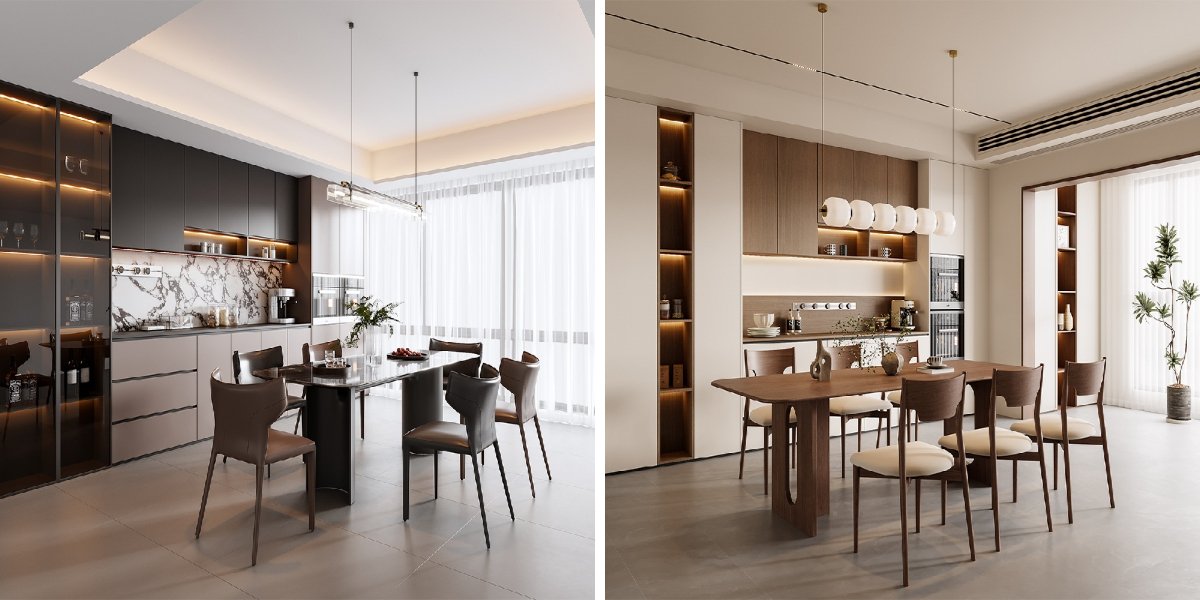
· Style Cohesion: The design must be a deliberate expression of a defined style—whether modern minimalist, luxury contemporary, rustic industrial, or classic—and must integrate seamlessly with the overall architectural theme of the building.
· Material & Textural Harmony: The juxtaposition of premium materials—such as solid wood, natural stone, sintered stone, metal, and high-performance fabrics—creates depth and a tactile sense of luxury.
· Lighting as a Design Element: Layered lighting (ambient, task, and accent) is crucial. A central statement chandelier or pendant, paired with wall sconces and dimmable LED systems, can transform the mood from bright and functional for breakfast to intimate and luxurious for dinner.
· Color Psychology: The palette significantly influences perception. Warm neutrals, deep earth tones, and rich accent colors create inviting, upscale environments, while sleek monochromatic schemes convey modern minimalism.
2026 Key Trends in Commercial Dining Room Design
Staying abreast of current trends is essential for B2B projects to ensure designs feel contemporary and competitive. The following trends are defining dining room design in 2026:
Curved & Organic Silhouettes
Sharp, linear designs are giving way to soft, curved forms. Round dining tables, arched banquettes, and furniture with rounded edges are dominant, as they promote a sense of flow, inclusivity, and comfort. Curves soften the space and are particularly effective in creating intimate dining zones within larger areas.
Sustainable & Tactile Materials
There is a strong shift towards eco-friendly dining room design. Reclaimed wood, FSC-certified timber, recycled metals, and low-VOC finishes are increasingly specified. Materials with natural, tactile textures—such as cerused wood (lime-washed to highlight grain), matte stone, and woven textiles—are preferred over high-gloss, artificial finishes, adding warmth and character.
Defined, Versatile Zones
Contrary to the open-concept trend, modern design is reintroducing defined dining spaces. Designers use architectural elements like ceiling height variations, distinct flooring, or partial partitions to create a sense of enclosure and formality, even within an open layout. This trend enhances the dining experience by providing a dedicated, focused area.
Mixed-Material Luxury
High-end projects are increasingly combining contrasting materials for a sophisticated, custom look: a sintered stone tabletop with a black metal base, a solid wood frame with upholstered leather accents, or brass inlays on marble. This fusion creates visual interest and signifies bespoke quality.
Technical Specifications & Material Standards for B2B Projects
For international buyers, dining room design must be backed by precise technical specifications to ensure quality, compliance, and longevity. Below are the industry standards for premium commercial-grade components:
Primary Materials & Performance Criteria
Table Tops: Solid Oak/Walnut, Sintered Stone, Marble, High-Pressure Laminate (HPL)
· Sintered Stone: Thickness 12–20mm, scratch-resistant (Mohs hardness 6+), stain-proof.
· Solid Wood: FSC-certified, moisture content 8–12% to prevent warping.
Chair Frames: Solid Beech/Rubber Wood, Stainless Steel, Aluminum Alloy
· Wood: Hardness grade HB or higher.
· Metal: 1.2–1.5mm thickness, electrostatic powder coating or PVD plating for corrosion resistance.
Upholstery: High-Density Foam, Fire-Retardant Fabric, Genuine Leather, Performance Velvet
· Foam: Density 35–45 kg/m³ for optimal comfort and resilience.
· Fabric: Martindale test rating ≥ 50,000 rubs (commercial grade), stain-resistant finish.
Cabinetry & Storage: E0/E1 Grade MDF, Multi-Ply Board, Melamine Faced Chipboard (MFC)
· Formaldehyde emission ≤ 0.05 ppm (E1/E0 standard).
· Panel thickness: Carcass 18mm, Back panel 9mm for structural stability.
Finishes: NC Lacquer, PU Lacquer, Water-Based Paint
· Abrasion resistance: ≥ 4H pencil hardness.
· UV resistance: Grade 8 (minimum) for color fastness.
Structural Design & Manufacturing Process
A reliable dining room design manufacturer follows a rigorous process to ensure structural integrity:
1. Engineering & Prototyping: Designs are structurally engineered using CAD software to support weights of up to 200kg per seating position. Prototypes undergo load-testing and durability cycles.
2. Precision Joinery: Commercial furniture utilizes mortise-and-tenon or dovetail joints for wooden frames, reinforced with corner blocks and high-quality adhesives for superior strength.
3. Quality Control (QC): Every piece undergoes strict QC checks for material conformity, dimensional accuracy, finish quality, and structural stability before packaging.
4. Modular & Customizable Solutions: To cater to large projects, designs are often modular, allowing for easy adaptation to specific spatial dimensions and bulk ordering.
International B2B Buyer Preferences & Common Pain Points
Understanding the priorities and challenges of global buyers is key to delivering effective dining room design solutions.
Top Buyer Preferences
· Customization: Over 70% of commercial buyers prioritize custom dining room design services to align with their brand identity and unique project dimensions. Generic, off-the-shelf solutions are rarely sufficient for high-end hotels or flagship restaurants.
· One-Stop Solution: Buyers prefer suppliers who offer a full turnkey service—from design conceptualization and 3D rendering to manufacturing, quality control, and logistics. This simplifies procurement and ensures design consistency.
· Cost-Effective Luxury: There is a strong demand for products that deliver a luxury dining room design aesthetic at a competitive wholesale price point. Buyers seek value through durable materials that reduce lifecycle costs.
· Short Lead Times: In the fast-paced construction and hospitality industry, reliable lead times (45–60 days for standard orders) are a critical decision-making factor.
· International Compliance: Products must meet regional standards, including ANSI/BIFMA (US), EN 1022 (EU), and various fire-safety regulations for upholstered furniture.
Common Buyer Pain Points
· Quality Inconsistency: Receiving products that differ from samples, with poor craftsmanship or inferior materials, is a major risk in global sourcing.
· Poor Space Utilization: Designs that look good on paper but fail to efficiently fit the actual space, leading to wasted square footage or cramped conditions.
· High Maintenance Requirements: Fragile materials or complex designs that result in high cleaning and repair costs over time.
· Logistics & Damage: Fragile items being damaged during long-distance shipping due to inadequate packaging.
A Step-by-Step Framework for Project Success
To consistently achieve a practical & elegant dining room design for commercial projects, follow this proven framework:
1: Requirement Analysis & Brand AlignmentConduct a detailed consultation to define the project's purpose (hotel, restaurant, apartment), target audience, brand style, and budget. Establish clear KPIs for functionality (seating capacity, durability) and aesthetics (mood, style).
2: Spatial Planning & Layout DesignCreate detailed 2D/3D floor plans optimizing traffic flow, seating capacity, and ergonomics. Select appropriate table shapes (round, rectangular, oval) and configurations (standard, booth, banquette) based on space and usage patterns.
3: Material & Finish SpecificationSelect materials from the technical standards list that balance aesthetic appeal with commercial-grade performance. Prioritize low-maintenance, durable, and eco-certified options.
4: Customization & DetailingIncorporate custom elements such as branded hardware, unique color matching, or tailored dimensions. Focus on refined details like edge profiles, decorative joinery, and accent lighting to elevate elegance.
5: Engineering & PrototypingValidate the structural integrity and ergonomics through engineering analysis and prototype testing.
6: Bulk Production & Quality AssuranceInitiate mass production under strict ISO 9001 quality management systems, with regular inspections to ensure every unit meets the approved sample specifications.
7: Packaging & LogisticsUtilize export-grade, protective packaging (EPE foam, corner guards, carton boxes) to prevent damage. Provide clear assembly instructions for flat-packed items.
Frequently Asked Questions
1.What is the lead time for a custom commercial dining room design order?
For standard custom orders, the typical lead time is 45–60 days from the confirmation of the final design and deposit. Complex, highly bespoke projects may require 60–90 days. We offer expedited production for urgent project deadlines.
2.Can your dining room designs comply with international fire safety standards?
Absolutely. All our upholstered items use fire-retardant foam and fabrics that meet CAL 117 (US), BS 5852 (UK), and EN 1021 (EU) standards, making them fully compliant for commercial use in major global markets.
3.How do you ensure the durability of your dining furniture for high-traffic hotels?
We exclusively use hospitality-grade materials and construction methods. Our frames are reinforced, our finishes are highly abrasion-resistant (≥4H), and our upholstery fabrics pass a 50,000-rub Martindale test. Each piece is load-tested to withstand over 200kg, ensuring longevity in commercial environments.
4.Do you provide design support and 3D renderings for project proposals?
Yes. Our professional design team provides free 3D renderings and space planning services for qualified bulk orders. We work closely with your architects and interior designers to ensure the dining room design integrates perfectly with your overall project vision.
Conclusion & Call to Action
Creating a practical & elegant dining room design for commercial projects is a complex discipline that demands technical expertise, material knowledge, and a keen aesthetic sense. It is an investment that significantly enhances the value and appeal of hotels, restaurants, and residential developments. By prioritizing commercial-grade functionality, customizable luxury, and adherence to the latest market trends, you can deliver spaces that impress clients, satisfy end-users, and ensure a strong return on investment.
If you are sourcing for your next hotel, restaurant, or large-scale residential project, we invite you to experience our expertise in commercial dining room design and custom solutions.
Contact us today to:
· Request a detailed project quote based on your specifications.
· Obtain comprehensive technical data sheets and material samples.
· Schedule a consultation with our design team for a free 3D layout proposal.
· Arrange for factory inspections or to view our portfolio of completed international projects.