How to Find a High-Quality Kitchen Cabinet Factory
Learn how to evaluate a kitchen cabinet factory for building projects. Discover custom kitchen cabinets, manufacturing standards, and supplier quality control.
In the global real estate and construction sectors, modern kitchen spaces serve as key drivers of property valuation and tenant satisfaction. For general contractors, property developers, and commercial procurement directors, sourcing kitchen cabinets for large-scale multi-family developments or luxury hospitality projects involves complex risk management. Selecting an underperforming manufacturing partner can lead to severe project delays, budget overruns, and compromised structural longevity.
Identifying a dependable production partner requires evaluating technical capabilities, material compliance, machinery, and quality control systems. This comprehensive industry analysis provides a structured framework for evaluating and selecting a high-quality manufacturing facility capable of delivering premium joinery solutions for major building projects.
Defining Manufacturing Competency in Architectural Joinery
Evaluating an industrial cabinet manufacturing facility extends far beyond reviewing marketing brochures or surface aesthetic samples. True production capability is anchored in raw material sourcing, technological infrastructure, and consistent manufacturing tolerances.
Precision Engineering and Modern CNC Processing Machinery
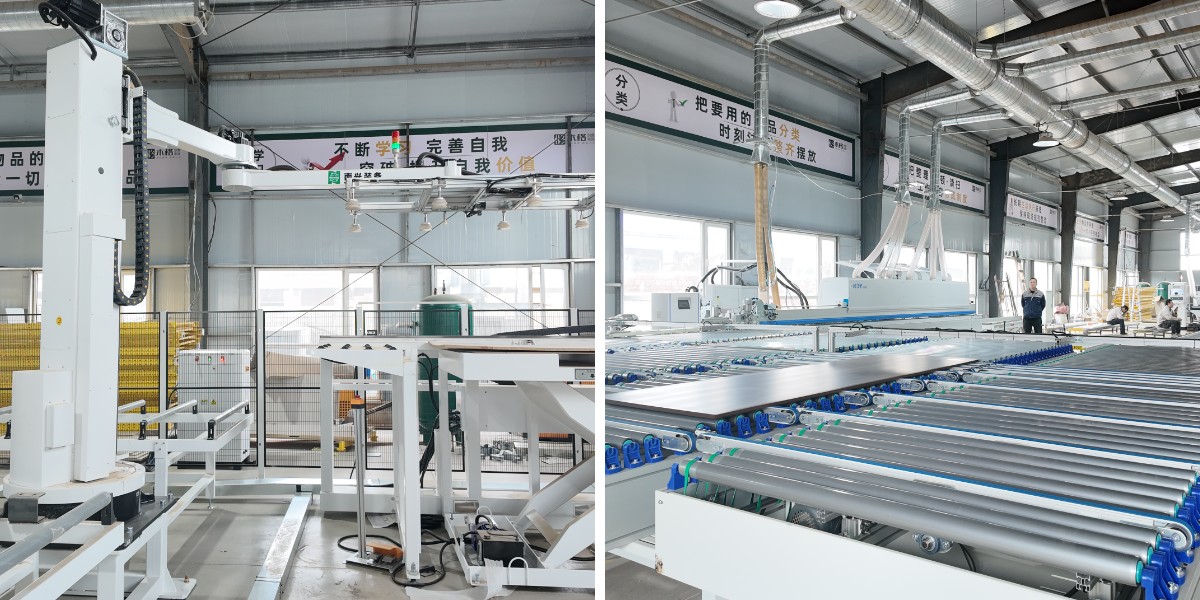
The transition from traditional workshop joinery to modern industrial cabinet manufacturing relies on automated processing technology. Leading production facilities utilize fully integrated Computer Numerical Control (CNC) machinery lines driven by advanced Building Information Modeling (BIM) and CAD/CAM software integrations.
High-precision panel processing minimizes dimensional variances, ensuring every carcass component, door panel, and shelf line conforms to strict millimeter tolerances. Precision edge-banding technology—utilizing Polyurethane (PUR) or Laser edge-bonding techniques—creates seamless, moisture-resistant joints that protect engineered wood cores from humidity, steam, and mechanical wear in demanding kitchen environments.
Raw Material Sourcing and Environmental Compliance
Material integrity dictates the structural lifespan of installed cabinetry systems. High-caliber factories maintain transparent supply chains for core substrates, including moisture-resistant medium-density fiberboard (MR-MDF), marine-grade plywood, and eco-friendly particleboards.
Formaldehyde Emission Standards: Premium export facilities ensure all wood composite substrates meet strict international environmental benchmarks, such as ENF, EPA TSCA Title VI, or European E1/E0 emission certifications.
Surface Coating Systems: Advanced finishing lines utilize UV-cured lacquers, high-pressure laminates (HPL), or natural wood veneers that resist yellowing, scratching, and chemical staining from household detergents.
Hardware System Integration: Top-tier suppliers partner with globally recognized hardware brands to integrate soft-close concealed hinges, heavy-duty drawer runner systems, and ergonomic lift-up mechanisms capable of enduring over 100,000 operational cycles.
Evaluating Factory Capacity, Production Workflow, and Scalability
For mid-to-large-scale real estate projects, a supplier’s production volume and workflow organization are critical parameters. A factory must demonstrate the operational bandwidth to process large-volume orders without compromising quality or delivery schedules.
Key Phases of Factory Sourcing Due Diligence
Technical and Material Verification: Comprehensive review of material safety data sheets, environmental compliance certificates, and structural joinery specs.
Automated Line Inspection: Evaluation of factory-floor CNC precision cutting equipment, edge-banding stations, and automated dust extraction infrastructure.
On-Site Quality Control Protocols: Assessment of incoming raw material testing, inline dimensional checks, and mandatory pre-shipment trial assemblies.
Export Logistics Readiness: Audit of protective packaging specifications, palletizing methods, and container loading efficiency.
Plant Footprint and Monthly Output Capacity
Operational footprint directly correlates with a factory's ability to handle simultaneous high-volume orders. Procurement managers should verify total plant floor space, the number of active production lines, and verified monthly container output metrics.
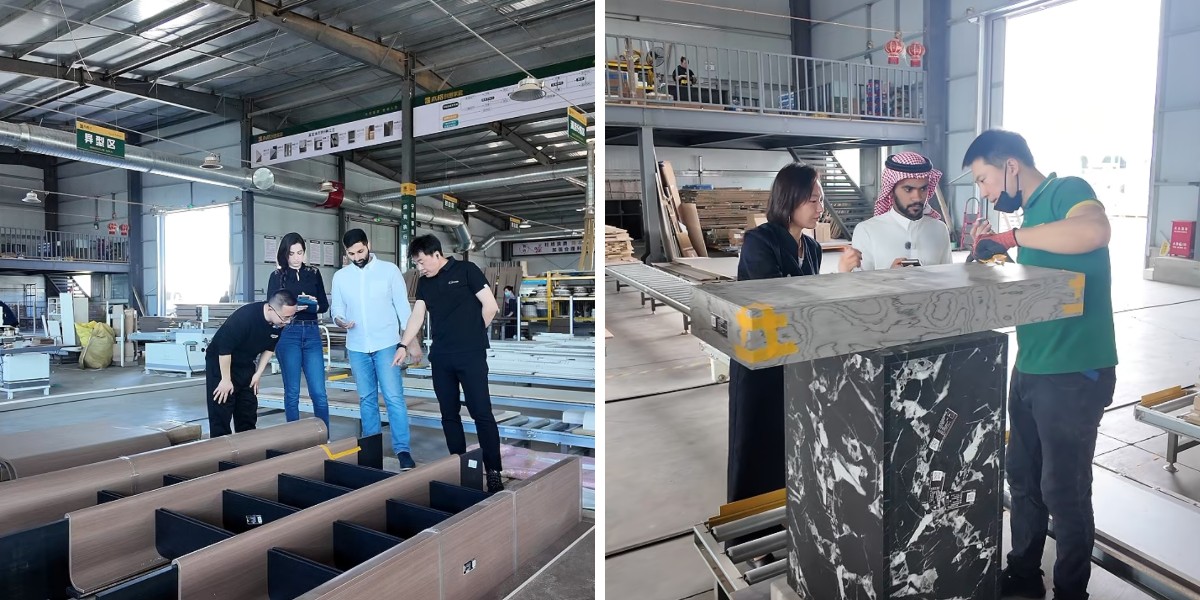
A well-organized manufacturing facility establishes dedicated zones for material storage, panel cutting, edge-sealing, drilling, trial assembly, finishing, and final export packaging. Clear division of labor and automated dust-extraction systems indicate a controlled manufacturing environment focused on worker safety and product consistency.
Trial Assembly Protocols and Quality Assurance Systems
A major indicator of a high-quality supplier is the implementation of mandatory pre-shipment trial assembly. Before flat-pack or fully assembled cabinets are packed for export, quality assurance inspectors must assemble representative batch samples to verify:
Dimensional Accuracy: Ensuring overall cabinet height, depth, and width conform strictly to approved architectural shop drawings.
Hardware Alignment: Verifying that pre-drilled hinge pilot holes and drawer slide runners align perfectly without requiring site modification.
Finish Consistency: Conducting color-matching inspections across adjacent door panels under standardized daylight conditions to prevent shade variations across installed kitchens.
Navigating International Sourcing Standards for Commercial Projects
Sourcing custom kitchen cabinets from international manufacturing hubs requires managing technical specifications, international trade regulations, and transportation safety protocols.
Architectural Shop Drawing Approvals and Prototyping
A professional manufacturing partner never proceeds directly to mass production without a rigorous shop drawing review process. The factory's engineering team converts architectural schematics into detailed production drawings specifying joinery details, drill patterns, edge-tape thicknesses, and hardware placement.
Contractors should request full-scale physical sample mockups or prototype units before signing off on mass production. Reviewing a physical sample allows project managers to inspect carcass joint rigidity, door edge-banding cleanliness, and surface coating quality in person.
Multi-Layer Export Packaging Engineering
Maritime transport subjects packaged cabinetry to humidity, thermal expansion, vibration, and handling impact. Sourcing managers must specify robust export packaging standards across four essential protective layers:
Protective Corner Guards: High-density plastic or heavy-duty reinforced cardboard corner protectors applied to all panel perimeters.
Surface Protection Sheets: Microfiber PE foam sheets shielding finished door faces and lacquered panels from friction damage during transit.
High-Burst Outer Enclosures: High-burst 5-ply corrugated cardboard boxes sealed against moisture and dust ingress.
Fumigated Wooden Palletizing: Heavy-duty fumigated wooden crates or reinforced pallets designed for multi-panel flat-pack cargo.
For large commercial orders, selecting a partner capable of supplying a fully integrated bifold closet door system alongside main kitchen cabinetry streamlines project procurement and reduces container consolidation overhead.
Essential Evaluation Criteria for B2B Procurement Teams
When conducting on-site factory audits or reviewing supplier bids for commercial residential projects, procurement teams should evaluate manufacturers against five core capability pillars:
1.Verified Project Portfolio: Examine documented case studies and photo evidence of completed high-rise residential, multi-family, or hotel projects delivered to international markets.
2.Third-Party Quality Management Certifications: Verify active ISO 9001 (Quality Management Systems) and ISO 14001 (Environmental Management) accreditation certificates.
3.Flexible Manufacturing Capabilities: Assess the supplier’s ability to produce specialized interior partitions, such as a top hung bifold door system, to provide unified material finishes across kitchen and adjoining pantry spaces.
4.Transparent Lead Times and Production Tracking: Ensure the factory utilizes Enterprise Resource Planning software to provide real-time updates on raw material arrival, machining progress, and packing schedules.
5.Comprehensive After-Sales Support: Confirm the inclusion of extra spare hardware, touch-up finish kits, and dedicated technical support for site installation teams.
The Role of Integrated Architectural Solutions in Modern Developments
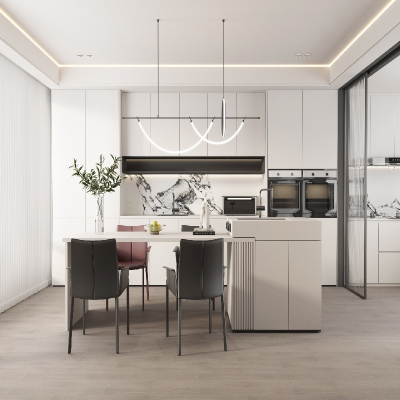
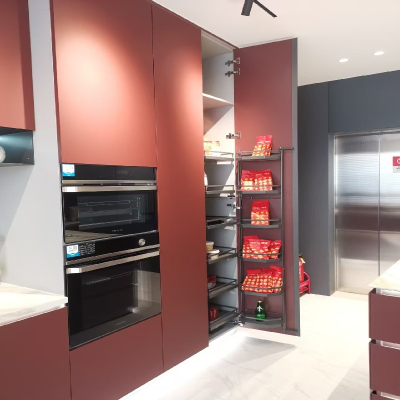
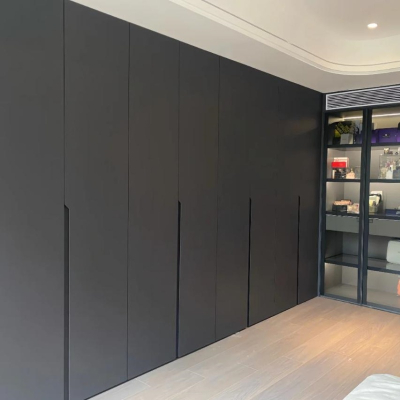
Contemporary residential developments increasingly favor unified interior design concepts where millwork finishes across kitchens, living room partitions, and wardrobe systems match seamlessly.
Partnering with a comprehensive joinery manufacturer that produces both kitchen cabinets and architectural glass partitions—such as interior bi-fold folding doors—allows developers to consolidate supplier management while achieving visual consistency across entire interior floor plans.
By sourcing all major joinery components from a single certified factory, project managers simplify shipping schedules, reduce port clearing costs, and ensure consistent material finishes across all residential units.
Conclusion: Securing Project Success Through Strategic Supplier Selection
Selecting a high-quality manufacturing partner for architectural cabinetry is a foundational decision that directly impacts building project timelines, profitability, and overall quality. By conducting thorough due diligence across automated machinery capabilities, raw material certifications, trial assembly protocols, and export packaging standards, procurement professionals can effectively mitigate sourcing risks.
Investing time in qualifying a reliable manufacturing partner ensures the delivery of durable, precisely engineered kitchen solutions that elevate property values and withstand decades of daily use.