Custom Tea Room Cabinets Design: B2B Buying Guide
Discover expert custom tea room cabinets design strategies, technical specifications, and global B2B procurement insights for luxury commercial spaces.
The resurgence of mindfulness-driven interior architecture has propelled specialized residential and commercial spaces into the forefront of global real estate development. Among these specialized environments, the dedicated tea room has evolved from a niche cultural enclave into a mainstream luxury amenity in high-end residences, boutique hospitality properties, and corporate wellness centers. For international property developers, interior architects, and B2B furniture importers, specifying the ideal millwork for these spaces requires an intricate balance of traditional aesthetic reverence and modern engineering precision.
Mastering custom tea room cabinets design demands a comprehensive understanding of global market drivers, ergonomic storage configurations, specialized material performance, and rigorous manufacturing tolerances. This article provides a definitive guide for industry professionals seeking to source or manufacture bespoke cabinetry that honors centuries-old tea culture while meeting the rigorous performance demands of contemporary commercial projects.
Global Market Dynamics and the Rise of Wellness-Centric Architecture
The international market for bespoke architectural millwork and specialized lifestyle furniture continues to experience robust expansion. Driven by a growing global emphasis on holistic well-being, mindfulness, and biophilic interior design, real estate developers across North America, Europe, and affluent Asian markets are increasingly incorporating dedicated meditation and tea-tasting spaces into high-end floor plans.
The Integration of Mindfulness Spaces: Modern luxury residential developments and boutique wellness resorts frequently allocate dedicated square footage to authentic tea rooms, creating a distinct market segment for specialized built-in cabinetry.
The Fusion of Eastern Craft and Western Ergonomics: Global buyers actively seek out manufacturing partners capable of blending minimalist Eastern aesthetics—such as shoji-inspired sliding panels and low-profile joinery—with modern Western demands for soft-close hardware, integrated LED ambient lighting, and heavy-duty load capacities.
Functional Anatomy and Structural Product Design
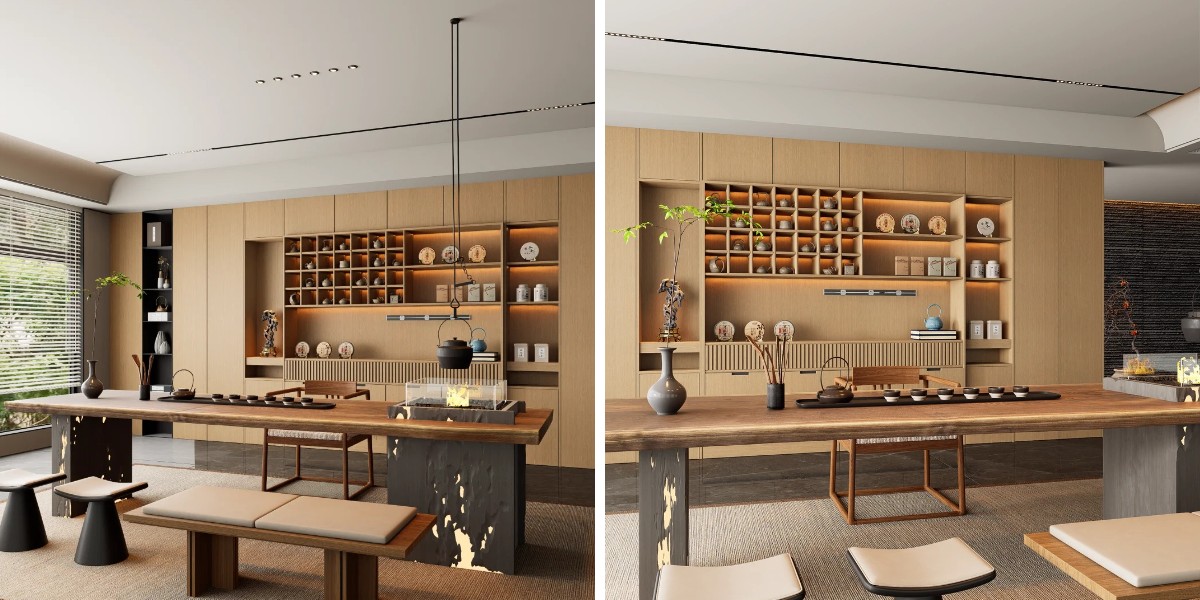
Unlike standard kitchen or office cabinetry, custom tea room cabinets design requires specialized internal architecture tailored specifically to the ceremonial storage and display of delicate teaware, Yixing clay pots, cast-iron kettles, and rare loose-leaf teas.
1. Specialized Storage Compartments and Display Zoning
A well-engineered tea cabinet must accommodate diverse storage requirements within a unified architectural facade:
Shallow-Depth Teaware Display Shelves: Open or glass-fronted upper display cabinets typically feature shallower depths (250mm to 300mm) to showcase ceramics and porcelain sets without stacking, preventing chipping and improving visual accessibility.
Moisture-Controlled Tea Leaf Storage: Specialized lower drawers or pull-out pantry modules equipped with airtight rubber gaskets and light-blocking solid wood fronts protect sensitive pu-erh, oolong, and green teas from ambient humidity, ultraviolet light, and odor contamination.
Integrated Water Station Integration: Many contemporary commercial and high-end residential tea cabinets feature reinforced countertops with concealed grommets and internal plumbing channels to house built-in boiling water dispensers and automated drainage basins.
2. Substrate Selection and Dimensional Stability
Because tea rooms often incorporate organic elements like bamboo, solid wood veneers, and exposed joinery, substrate stability is paramount. Export-grade manufacturing relies on multi-layered, moisture-resistant plywood cores or high-density fiberboard (MDF) engineered to withstand micro-climate shifts without warping, cracking, or joint separation.
Manufacturing Workflows, Hardware, and Quality Control
Producing elite-tier millwork for international export requires an exacting factory workflow that bridges traditional craftsmanship with advanced industrial automation.
1. Precision CNC Machining and Traditional Joinery
Automated CNC nesting machinery executes millimeter-precise cuts for cabinet boxes, complex partition grids, and frame assemblies. However, premier custom tea room cabinets design often integrates traditional mortise-and-tenon or finger-joint construction for exposed elements, ensuring structural integrity that withstands decades of daily manipulation.
2. Advanced Surface Finishes and Edge Banding
To preserve the natural aesthetic of timbers like white oak, walnut, and ash, manufacturers apply low-VOC, water-based matte polyurethanes or natural hardwax oils that resist staining from water droplets and tea spills. Furthermore, concealed edges utilize PUR (Polyurethane) waterproof edge banding to create an invisible, highly durable moisture barrier that prevents steam damage from boiling water kettles.
3. Factory Pre-Assembly and Rigorous Cycle Testing
Prior to packaging, full factory pre-assembly runs are conducted to verify door alignments, drawer slide tolerances, and integrated LED wiring channels. Hardware components—including concealed soft-close hinges, touch-latches, and heavy-duty undermount slides—undergo rigorous cycle testing exceeding 100,000 movements to guarantee long-term operational reliability.
International Buyer Preferences, Procurement Challenges, and Solutions
Global property developers and commercial importers frequently encounter specific hurdles when sourcing custom architectural millwork from overseas manufacturing hubs.
Common Procurement Challenges
Tolerance Mismatches on Site: Minor dimensional discrepancies across large runs of bespoke millwork can complicate on-site installation, resulting in uneven shadow gaps and misaligned doors.
Environmental Sensitivity: Variations in relative humidity between the manufacturing facility and the final destination can cause solid wood components to swell or contract, risking surface checking.
Transit Vulnerability: Long-distance ocean freight exposes fragile glass doors, delicate ceramic storage inserts, and fine wood finishes to mechanical shock and moisture shifts
Frequently Asked Questions (FAQ)
1. What are the key material considerations for custom tea room cabinets design?
The design must prioritize moisture-resistant engineered substrates, food-safe and low-VOC surface finishes, and specialized airtight compartments to protect delicate tea leaves from humidity, light, and ambient odors.
2. How can custom tea cabinets accommodate modern water heating and drainage systems?
Manufacturers engineer reinforced countertops, internal utility chases, and concealed service access panels to seamlessly integrate boiling water dispensers, filtration units, and waste drainage basins without compromising aesthetic minimalism.
3. Are traditional joinery techniques durable enough for commercial hospitality environments?
Yes. When combined with modern structural reinforcement, traditional joinery methods like mortise-and-tenon construction provide exceptional tensile strength and long-term durability for high-traffic commercial tea rooms and wellness lounges.
4. What is the standard lead time for custom B2B tea cabinetry manufacturing and global delivery?
Standard production lead times typically range from 4 to 6 weeks, accommodating custom material sourcing, precision CNC fabrication, pre-assembly quality inspections, and international ocean freight coordination.
Elevate Your Wellness Spaces with Bespoke Cabinetry Solutions
Are you an interior architect, real estate developer, or commercial furniture distributor seeking a world-class manufacturing partner for your upcoming wellness or hospitality portfolio? Partner with an industry leader dedicated to precision engineering, sustainable materials, and seamless global supply chain execution for custom tea room cabinets design.
Contact our export sales engineering team today to request comprehensive technical data sheets, CAD libraries, material finish samples, and a customized project quotation tailored to your exact specifications.