Modern Kids Closet Design: 2026 Storage Ideas
Explore expert modern kids closet design strategies, 2026 storage trends, technical specifications, and global B2B procurement insights.
Modern Kids Closet Design: Space-Saving Storage Ideas for 2026
The evolution of contemporary residential architecture demands that every square foot of interior space performs with maximum efficiency, and children's living environments are no exception. As families increasingly invest in adaptable, long-lasting home interiors, modern kids closet design has transitioned from basic shelving into a sophisticated discipline of architectural millwork. For global property developers, interior architects, and high-end B2B furniture importers, specifying custom closet solutions that adapt to a child's changing developmental stages is vital for capturing today’s high-value residential market.
Mastering modern kids closet design requires an intricate balance of ergonomic accessibility, safety-compliant engineering, and modular flexibility. This article provides a definitive analysis for international industry professionals seeking to source or manufacture bespoke storage systems that combine playful functionality with rigorous commercial-grade manufacturing standards.
Global Market Dynamics and the Shift Toward Adaptable Millwork
The international market for custom children’s storage and residential millwork continues to experience robust expansion, driven by urbanization, compact multi-family housing developments, and a rising consumer preference for sustainable, long-term investments. According to recent global housing market and architectural interior trends, modern families are moving away from temporary, lightweight plastic organizers in favor of built-in wood and metal cabinetry designed to last through a child's adolescence.
The Rise of Adaptable Spaces: Modern real estate developments emphasize multi-functional rooms that can evolve as children grow, fueling a high demand for adjustable shelving and reconfigurable wardrobe components within any modern kids closet design layout.
The Integration of Biophilic and Safe Materials: Discerning parents and commercial specifiers mandate non-toxic, low-VOC surface treatments and certified sustainable engineered woods that protect indoor air quality in children's bedrooms.
Maximizing Urban Square Footage: High-density metropolitan housing across North America and Europe requires innovative vertical storage configurations that eliminate clutter while maintaining clean, minimalist architectural lines.
Strategic Long-Tail Keywords for Global B2B Export
To capture high-intent international search traffic and optimize digital catalogs for wholesale procurement, export manufacturers must seamlessly integrate precise search phrases. This article strategically incorporates the primary keyword alongside the following core long-tail search terms:
modern kids closet design
space-saving children's wardrobe systems
adjustable height shelving for kids
eco-friendly nursery and youth cabinetry
safe soft-close nursery hardware
custom B2B modular millwork export
Functional Anatomy and Ergonomic Product Structure
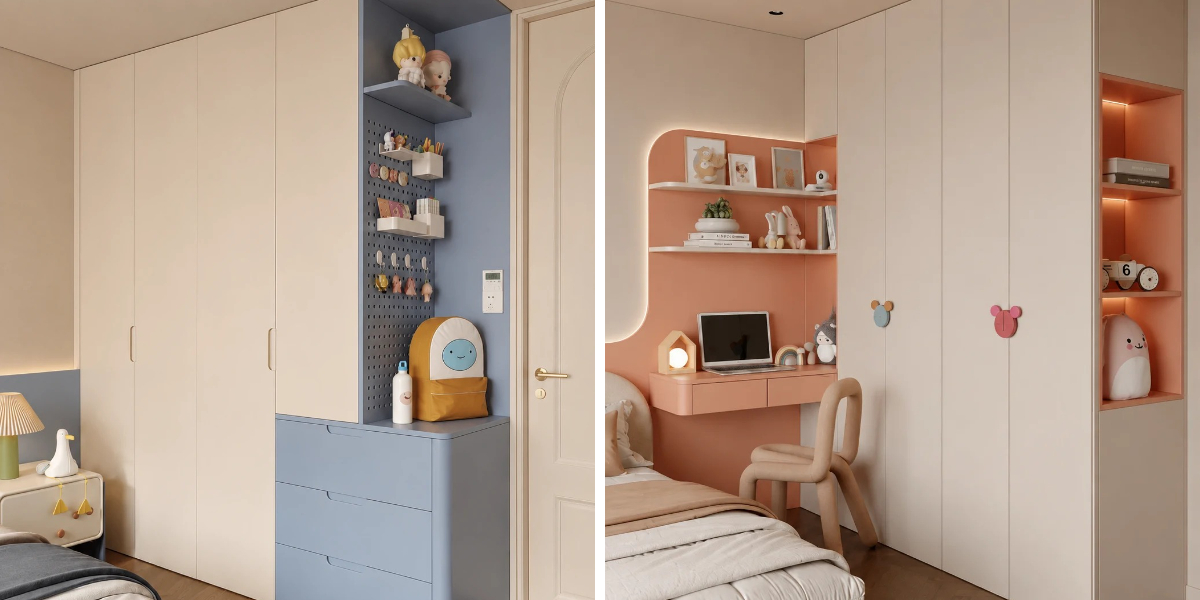
Unlike standard adult wardrobing, a successful modern kids closet design must account for changing physical heights, safety protocols, and diverse storage categories ranging from bulky toys to folded garments and hanging school attire.
1. Multi-Tiered Hanging and Adjustable Zoning
Because children’s clothing scales rapidly in length as they grow, rigid fixed-height clothing rods fail to offer long-term utility. Premium modern kids closet design integrates vertical slot tracks or multi-level hanging tiers:
Low-Level Accessible Rods: Positioned at lower heights for toddlers and young children to encourage independent self-care and clothing organization habits.
Upper Convertible Rods: Higher hanging zones equipped with removable or adjustable brackets that can be lowered as the child transitions into pre-adolescence and teenage years.
Open Cubby Integration: Modular open cubbies designed for canvas bins, shoe storage, and daily school accessories, maintaining visual accessibility.
2. Substrate Selection and Environmental Compliance
Because children are more sensitive to indoor chemical emissions, material selection is subject to intense regulatory scrutiny. Export-grade manufacturing relies on CARB Phase 2 and E0-compliant high-density fiberboard (MDF) or moisture-resistant multi-layered plywood cores. These substrates ensure structural rigidity while eliminating formaldehyde hazards, paired with low-VOC water-based finishes or durable thermal-fused laminates.
Manufacturing Workflows, Hardware Integration, and Safety Protocols
Producing commercial-grade millwork for international export demands an exacting factory workflow that marries advanced automation with rigorous child-safety engineering.
1. Precision CNC Machining and Edge Banding
Automated CNC nesting machinery executes millimeter-precise cuts for cabinet boxes, vertical panel slots, and custom divider grids. To prevent moisture absorption and chipping from daily wear, all exposed and concealed edges utilize PUR (Polyurethane) waterproof edge banding, creating an impenetrable, smooth barrier free of sharp burrs.
2. Child-Safe Hardware and Soft-Close Mechanisms
Safety is the paramount engineering pillar in any modern kids closet design. Premium production runs incorporate heavy-duty concealed hinges and undermount drawer slides equipped with advanced soft-close dampeners. These dampeners prevent sudden slamming, protecting small fingers from pinch injuries. Furthermore, anti-tip wall-anchoring brackets and recessed finger-pull channels eliminate the need for protruding handles that could cause snagging or impact injuries.
3. Factory Pre-Assembly and Rigorous Cycle Testing
Prior to ocean shipping, full factory pre-assembly runs are conducted to verify drawer slide tolerances, shelf pin stability, and structural squareness. Hardware components undergo cycle testing exceeding 100,000 movements to guarantee long-term operational resilience under heavy residential usage.
International Buyer Preferences, Procurement Challenges, and Solutions
Global property developers, multi-family contractors, and furniture importers frequently encounter specific logistics and installation hurdles when sourcing specialized youth cabinetry from overseas manufacturing hubs.
Common Procurement Challenges
On-Site Installation Inconsistencies: Variations in room dimensions across large-scale residential developments can complicate the installation of fixed-width wardrobe units, creating unsightly gaps.
Climate-Induced Wood Movement: Long-distance ocean freight across diverse humidity zones can cause inferior wood substrates to warp, compromising door alignment and sliding mechanisms.
Regulatory Certification Friction: Strict international import standards require verifiable proof of environmental compliance, chemical safety, and structural load testing.
Professional Export Solutions
Leading B2B manufacturers mitigate these risks by supplying modular components with universal pre-drilled pilot holes, comprehensive shop drawings, and adjustable leveling feet to absorb floor and wall irregularities. Additionally, export shipments utilize heavy-duty corrugated cartons, reinforced fumigation-free plywood crating, and high-density foam corner protectors to ensure structural safety throughout international shipping lanes.
Frequently Asked Questions (FAQ)
1. What are the key safety features required in modern kids closet design?
Essential safety features include anti-tip wall anchoring hardware, soft-close drawer slides and hinges to prevent finger pinching, rounded edge-banding profiles, and flush or integrated finger-pull channels instead of protruding knobs.
2. How do adjustable systems accommodate a growing child's changing wardrobe needs?
Systems utilize vertical slotted wall standards or modular pre-bored panel holes, allowing parents or installers to easily reposition hanging rods, pull-out baskets, and shelf heights as the child grows from toddlerhood to teenagers.
3. What environmental and emission standards apply to export-grade youth cabinetry?
Export-grade children's cabinetry must comply with strict international benchmarks such as ENF and E0 formaldehyde emission standards, utilizing low-VOC finishes and sustainable engineered wood substrates.
4. What is the standard lead time for custom B2B modular closet manufacturing and delivery?
Standard production lead times typically range from 4 to 6 weeks, encompassing custom material sourcing, precision CNC fabrication, pre-assembly quality checks, and international logistics coordination.
Elevate Your Residential Projects with Bespoke Storage Solutions
Are you an interior architect, residential property developer, or commercial furniture distributor seeking a dependable manufacturing partner for your upcoming housing portfolio? Partner with an industry leader dedicated to precision engineering, child-safe hardware, and sustainable materials for modern kids closet design.
Contact our export sales engineering team today to request comprehensive technical data sheets, CAD libraries, material finish samples, and a customized project quotation tailored to your exact commercial specifications.