Custom Wardrobes & Plywood Solutions for Real Estate
Discover how high-durability custom wardrobes and premium plywood solutions drive modern real estate projects with superior structural integrity and design flexibility.
Driving Modern Real Estate Excellence: The Role of Custom Wardrobes and Plywood Solutions
Global Industry Background and Market Dynamics
The global real estate development, property investment, and interior architecture sectors are currently undergoing a profound and irreversible structural transformation. As global urbanization accelerates and urban population densities rise steadily across major metropolitan centers, real estate developers, commercial contractors, and residential architects face mounting pressure to maximize usable interior space while simultaneously elevating aesthetic, functional, and structural standards. Modern property buyers, tenants, and commercial investors no longer view interior storage as a mere utility, a secondary consideration, or an afterthought; instead, they demand sophisticated, architectural-grade fixtures that seamlessly blend with luxury interior design concepts and high-end lifestyle expectations. This definitive shift has placed high-end interior joinery—specifically built-in storage systems and custom wardrobe installations—at the absolute center of modern property valuation, tenant acquisition, and competitive market differentiation.
Market intelligence reports and industry forecasts indicate steady, robust expansion within the global architectural millwork and built-in furniture sector. Urbanization trends across North America, Western Europe, the Middle East, and rapidly growing urban nodes in the Asia-Pacific region continue to drive large-scale capital investments in multi-family residential complexes, upscale hospitality portfolios, mixed-use commercial developments, and high-end private villas. Developers operating in these competitive international markets recognize that exceptional interior details, premium material finishes, and flawless joinery significantly shorten property absorption periods, enhance long-term tenant retention, and increase overall asset valuation upon resale. Consequently, professional procurement strategies have shifted decisively away from generic, mass-produced flat-pack furniture toward engineered, highly customized interior solutions that can be scaled efficiently across entire development portfolios without compromising on individual unit character, structural integrity, or architectural coherence. Furthermore, modern real estate investors increasingly demand supply chain transparency, requiring manufacturing partners who can guarantee consistent quality control, adherence to strict delivery schedules, and compliance with international building codes from the initial blueprint stage through to final on-site installation.
Market Data and Regional Demand Analysis
Quantitative metrics and trade analyses underscore the rising commercial value of specialized interior architectural products within contemporary real estate portfolios. Industry research reveals that built-in storage and custom wardrobe installations account for a substantial percentage of total interior fit-out budgets in modern residential, commercial, and hospitality developments. In urban hubs experiencing persistently high real estate acquisition and construction costs, optimizing every square inch of available floor space is paramount for project profitability. Developers actively source customized solutions that eliminate wasted spatial pockets, transforming irregular architectural layouts, structural columns, and recessed walls into functional, high-value living areas that appeal directly to discerning buyers.
Demand patterns vary distinctively across international geographic markets, exerting a direct influence on material specifications, finish preferences, and manufacturing execution requirements:
North American and European Markets: Procurement managers, general contractors, and architectural specifiers prioritize stringent environmental compliance and ecological sustainability. They demand rigorous low-emission certifications, sustainable wood sourcing documentation, and minimalist aesthetic profiles that appeal to eco-conscious homeowners and align with green building standards.
Middle Eastern and Luxury Hospitality Markets: Developers lean heavily toward high-end custom configurations featuring integrated LED illumination, architectural glass display elements, and heavy-duty hardware systems capable of enduring intensive commercial use while projecting uncompromised luxury, opulence, and architectural refinement.
Asia-Pacific Urban Developments: Projects emphasize modular flexibility, spatial adaptability, and space-saving engineering, requiring robust multi-functional storage solutions that integrate seamlessly into compact luxury apartments, high-density residential towers, and multi-generational housing units.
Evolving Trends in Modern Interior Architecture
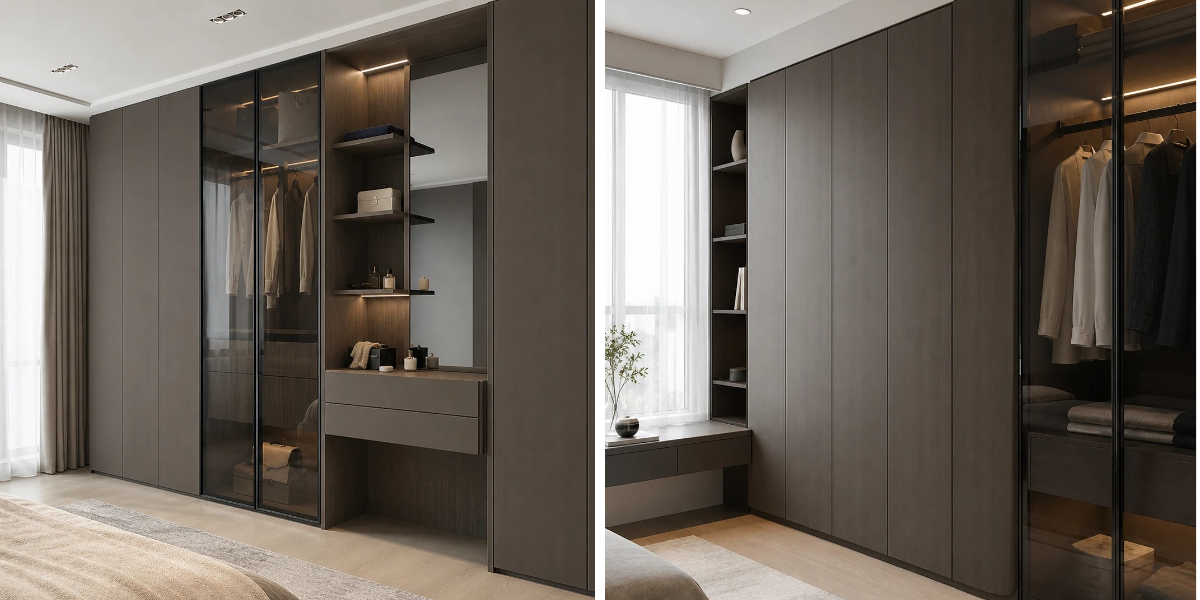
Contemporary interior design trends emphasize clean lines, uninterrupted architectural surfaces, and a harmonious, balanced relationship between concealed storage and open display elements. The dominant minimalist movement has fundamentally reshaped how wardrobes are conceptualized within architectural blueprints. Traditional bulky frames, heavy exterior moldings, and protruding hardware handles are being systematically replaced by handleless, push-to-open mechanisms, synchronized sliding systems, and floor-to-ceiling vertical profiles that elongate visual sightlines and create an illusion of expansive interior volume.
Furthermore, the integration of ambient lighting within storage architecture has transitioned from a luxury upgrade to a standard specification in high-end real estate projects. Built-in LED channels, motion-sensor illumination, and glass-door display cabinets transform functional wardrobes into sophisticated display showcases for luxury garments, footwear, and personal accessories. This convergence of advanced lighting engineering and fine carpentry requires exceptional manufacturing precision, making technical collaboration between real estate developers and specialized manufacturing partners more critical than ever to ensure seamless electrical integration and flawless aesthetic execution.
Addressing International Buyer Procurement Pain Points
Global B2B buyers—including property developers, real estate investment trusts (REITs), architectural firms, and large-scale importers—frequently encounter distinct operational and technical challenges when sourcing architectural millwork internationally. Understanding and resolving these pain points is essential for establishing resilient, long-term supply chains.
Structural Deformation and Humidity Challenges
A primary concern for international procurement teams is the susceptibility of wood-based panels to warping, swelling, and structural degradation when exposed to varying climatic conditions. Shipping furniture across international borders—from temperate manufacturing hubs to humid coastal regions or arid desert environments—exposes materials to severe thermal and moisture fluctuations. Standard particleboard or low-grade MDF often fails under these conditions, leading to jammed doors, sagging shelves, and costly warranty claims for developers.
Environmental Compliance and Indoor Air Quality
Regulatory frameworks regarding indoor air quality have become significantly stringent worldwide. Real estate projects aiming for green building certifications (such as LEED, BREEAM, or local equivalents) require strict verification of formaldehyde emission levels. Procuring uncertified or substandard cabinetry exposes developers to severe legal risks, project delays, and reputational damage.
Supply Chain Consistency and Installation Efficiency
On modern construction sites, time is capital. Delays caused by miscalculated dimensions, missing hardware, or complex, unstructured installation processes can derail tight project schedules. B2B buyers require manufacturing partners who deliver precision-engineered modular systems equipped with comprehensive technical documentation, clear assembly guidelines, and standardized hardware that minimizes on-site labor hours.
Technical Superiority of Plywood Solutions in Architectural Millwork
Why Plywood Outperforms Traditional Substrates
In response to rigorous structural and environmental demands, high-grade plywood has emerged as the definitive material of choice for premium architectural millwork and custom wardrobes. Unlike standard particleboard or medium-density fiberboard (MDF), which rely on bonded wood dust and possess limited structural rigidity, plywood is engineered using a cross-laminated veneer construction methodology.
This multi-layered core architecture distributes mechanical stress evenly across the panel. When subjected to heavy hanging loads—such as winter overcoats, tailored suits, and dense storage inventories—plywood substrates resist bending, sagging, and structural fatigue. For real estate developers and commercial contractors seeking long-term durability and structural integrity, specifying high-grade plywood solutions eliminates post-installation callbacks and significantly extends the lifecycle of the interior fit-out.
Environmental Safety and Moisture Resistance
Modern plywood solutions engineered for international export are manufactured using advanced, eco-friendly adhesive technologies that comply with stringent global emission thresholds, including CARB Phase 2 and E0-grade standards. These low-emission resins ensure that indoor air quality remains pristine, satisfying the health and safety requirements of luxury residential and institutional projects.
In addition to environmental safety, advanced plywood substrates undergo specialized moisture-resistant treatments during production. Sealed with high-integrity PUR (Polyurethane Reactive) edge-banding and treated core resins, these panels exhibit exceptional resistance to humidity, thermal expansion, and water vapor absorption. This makes them ideal for high-humidity residential environments, coastal real estate developments, and tropical hospitality projects where standard wood products would otherwise degrade.
Precision Engineering: Hardware, Customization, and Manufacturing Workflow
Advanced Hardware Configuration for Seamless Operation
The tactile experience of a high-end wardrobe is dictated by the quality of its mechanical hardware. Precision engineering ensures that heavy cabinet doors and fully loaded drawers operate with absolute silence and effortless control.
Hydraulic Soft-Close Hinges: Modern custom wardrobes incorporate corrosion-resistant, high-grade steel hinges engineered to withstand tens of thousands of continuous opening and closing cycles. Integrated hydraulic damping mechanisms prevent abrupt slamming, protecting structural joints and eliminating noise pollution in luxury living spaces.
Synchronized Undermount Slide Rails: Concealed undermount drawer slides equipped with precision ball-bearing assemblies and soft-close technology ensure smooth, full-extension pulling performance under maximum load weights. This hardware configuration preserves a clean, minimalist exterior aesthetic while delivering superior mechanical reliability.
Tailored Customization and Modular Design Flexibility
Architectural spaces rarely conform to standardized dimensions. To accommodate the unique blueprints of luxury villas, penthouse apartments, and boutique hotels, manufacturing operations must offer extensive custom flexibility.
Flexibility extends across multiple dimensions:
Dimensional Adaptability: Custom height, width, and depth parameters allow interior designers to utilize every square centimeter of available wall space, bridging structural columns and architectural irregularities seamlessly.
Internal Modular Configurations: Adaptable interior components—such as adjustable shelving, pull-out trouser racks, integrated lighting rods, and velvet-lined jewelry drawers—enable end-users to customize storage layouts to their exact lifestyle requirements.
Surface Finish Versatility: A broad spectrum of sophisticated matte, high-grade textured wood-grain, and specialized lacquer finishes ensures absolute harmonization with overarching interior design themes.
Frequently Asked Questions (FAQ)
What makes plywood solutions superior to particleboard for custom wardrobes in real estate projects?
Plywood features a cross-laminated veneer core construction that provides exceptional structural strength, superior load-bearing capacity, and high resistance to bending under heavy garment weights. Unlike particleboard, plywood is naturally more resilient against moisture and humidity, preventing structural warping and ensuring long-term durability in diverse climatic conditions.
Can custom wardrobes be manufactured to fit non-standard room dimensions and architectural irregularities?
Yes. Professional manufacturing operations support fully flexible customization in height, width, and depth. This allows architects and contractors to tailor each wardrobe unit precisely to unique spatial blueprints, maximizing storage efficiency in luxury residential and commercial developments.
What environmental and safety certifications do your wood substrates meet?
Our manufacturing processes utilize high-density engineered wood boards and advanced adhesives that strictly comply with international environmental benchmarks, including CARB Phase 2 and E0-grade standards, ensuring minimal formaldehyde emissions and healthy indoor air quality.
How are large-scale custom wardrobe orders packaged and shipped internationally to prevent transit damage?
Export-grade packaging utilizes multi-layer protection systems, including heavy-duty corrugated cartons, reinforced protective edge guards, EPE foam padding, and internal bracing. This rigorous packaging protocol safeguards structural panels, glass components, and precision hardware against transit shocks during international maritime freight.
Empower Your Next Real Estate Project with Elite Custom Storage Solutions
Elevate the standard of your upcoming residential, hospitality, or commercial development with precision-engineered, high-durability wardrobe solutions. Partner with a trusted global manufacturer dedicated to uncompromised craftsmanship, stringent environmental compliance, and seamless project execution.
Contact our export engineering team today to request comprehensive technical data sheets, material sample kits, and a customized project quotation tailored to your architectural specifications.