How to Choose the Ideal Grey Wardrobe for Modern Projects
Discover how to select the ideal grey wardrobe for modern interior projects. Learn key trends, technical specs, and sourcing insights from a top manufacturer.
How to Choose the Ideal Grey Wardrobe for Modern Interior Projects
The interior design and real estate development sectors have undergone a profound transformation over the past decade. Modern architectural trends increasingly favor minimalist aesthetics, clean lines, and neutral color palettes that maximize spatial perception and psychological comfort. Among these design choices, the grey wardrobe has emerged as a definitive staple in contemporary residential and commercial real estate. From high-end luxury apartments in metropolitan hubs to expansive suburban single-family homes and boutique hospitality projects, the demand for versatile, sophisticated storage solutions has accelerated at an unprecedented pace.
For international B2B buyers, property developers, and interior designers, selecting the right storage fixtures goes beyond mere visual appeal. It requires a comprehensive understanding of global market dynamics, material engineering, advanced manufacturing standards, and structural customization capabilities. Navigating these requirements successfully ensures long-term project durability, client satisfaction, and maximized commercial value. In today's competitive real estate landscape, architectural millwork is no longer viewed as a secondary utility; rather, it functions as a core design element that defines the sophistication and functional caliber of high-end living spaces.
Global Market Trends and Industry Dynamics
The Shift Toward Neutral Tones in Modern Architecture
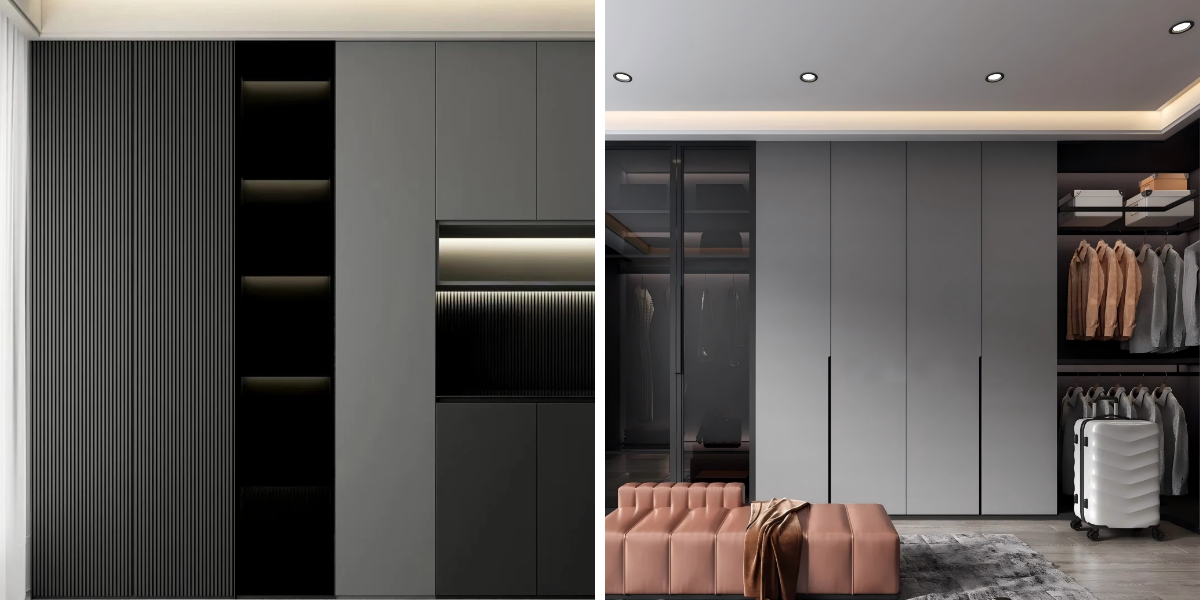
Global interior architecture has shifted decisively away from heavy, ornate wooden furnishings toward understated, streamlined alternatives. Neutral shades—particularly various iterations of grey, taupe, and charcoal—dominate contemporary architectural specifications. A grey wardrobe serves as a neutral anchor within a bedroom ecosystem, effortlessly bridging the gap between contrasting wall colors, metallic hardware finishes, and textured flooring materials. This chromatic versatility explains its widespread adoption across diverse geographical markets, spanning North American transitional spaces, European minimalist apartments, and modern Middle Eastern luxury villas.
Furthermore, psychological studies in interior design indicate that muted grey tones evoke a sense of calm, order, and spatial expansiveness. As urban living spaces face increasing spatial constraints, property developers are turning to built-in wardrobe solutions that harmonize with light-reflecting wall finishes to create an illusion of greater room volume. This aesthetic preference drives continuous innovation in matte surface textures, anti-fingerprint coatings, and subtle grain patterns that maintain visual interest without overwhelming the sensory balance of a private sanctuary.
Rising Demand for Tailored B2B Customization
Modern real estate projects rarely conform to one-size-fits-all dimensions. Real estate developers, general contractors, and wholesale distributors increasingly demand flexible procurement channels that accommodate specific architectural blueprints. Sourcing from a reliable grey wardrobe manufacturer allows procurement teams to bypass the rigid limitations of off-the-shelf retail inventory. By utilizing Custom Grey Wardrobe Solutions, project managers can ensure exact millimeter-level dimensional compliance, structural uniformity, and aesthetic continuity across hundreds of multi-family residential units or hotel suites.
The economic advantages of direct-to-factory customization are substantial. Bulk procurement through tailored B2B channels ensures that every single unit is engineered precisely to match structural recesses, ceiling heights, and corner angles, eliminating unsightly filler panels and costly on-site modifications. This level of customization also extends to interior configurations, allowing developers to cater to specific target demographics—whether young urban professionals requiring extensive shoe and accessory displays or family-oriented buyers needing robust double-hanging garment areas and heavy-duty shelving.
Key Technical Specifications and Structural Engineering
Premium Substrate Materials and Core Integrity
The structural longevity of any architectural casework depends fundamentally on the underlying substrate materials. Reputable global suppliers avoid warping-prone, low-grade alternatives, instead utilizing high-density engineered wood boards, moisture-resistant medium-density fiberboard (MDF), and durable particle boards that comply with international CARB Phase 2 or E0/E1 formaldehyde emission standards. These materials provide a stable, flat surface ideal for high-end flat-panel finishing, ensuring that the grey wardrobe maintains its structural integrity and visual smoothness over years of intensive daily use.
In addition to core stability, environmental safety has become a paramount concern for international importers and green building certifiers. Modern production facilities employ advanced pressing technologies that minimize adhesive usage while maximizing internal bonding strength. This rigorous approach prevents board sagging under heavy garment loads and protects against internal stress fractures caused by seasonal humidity shifts. Consequently, the finished wardrobe withstands structural fatigue, maintaining smooth door alignment and reliable hardware engagement over thousands of operational cycles.
Advanced Surface Finishes and Edge Banding
Aesthetics are defined by tactile feel and visual perfection. High-end units utilize advanced melamine, laminate, or specialized lacquer coating technologies to deliver consistent matte or soft-touch finishes that resist fingerprints, minor scratches, and UV degradation. Furthermore, state-of-the-art PUR (Polyurethane Reactive) edge-banding technology seals panel perimeters tightly. This precision application prevents moisture ingress, eliminates edge peeling, and preserves the pristine appearance of the grey wardrobe even in humid coastal environments or tropical real estate developments.
The application of PUR edge-banding represents a significant leap forward in manufacturing science compared to traditional EVA hot-melt adhesives. PUR bonds exhibit vastly superior resistance to heat, moisture, and chemical cleaning agents, creating an invisible, seamless joint between the edge tape and the board face. This technical refinement not only enhances the visual elegance of flat-panel doors and cabinet frames but also guarantees that commercial-grade installations maintain their factory-fresh presentation throughout long-term occupancy cycles.
Innovative Storage Technologies and Functional Features
Smart Integration: Lighting and Spatial Optimization
Modern users expect furniture to integrate seamlessly with contemporary lifestyles. The inclusion of smart design elements elevates standard storage into an elite tier of interior engineering. For instance, incorporating a Minimalist Grey Wardrobe with Integrated Intelligent Storage Design introduces sophisticated spatial efficiency through automated touch-latch mechanisms, pull-out trouser racks, and concealed velvet-lined accessory drawers.
Spatial organization inside a high-end wardrobe must balance accessibility with visual minimalism. Advanced layouts utilize modular zoning principles, dividing vertical storage into dedicated tiers for long garments, short apparel, folded items, and footwear. By integrating specialized hardware components such as hydraulic pull-down hanging rails and side-mounted belt racks, designers eliminate wasted vertical volume, ensuring that every square centimeter of internal space serves a purposeful function.
Seamless Illumination Solutions
Lighting plays a vital role in high-end wardrobe functionality. Integrating a Modern Minimalist Grey Wardrobe with Integrated LED Lighting - Custom Size transforms the user experience by introducing motion-sensor-activated vertical light strips and recessed shelf illumination. These low-voltage, energy-efficient lighting systems illuminate dark corners, accentuate garment textures, and provide a luxurious, boutique-like ambiance without cluttering the clean architectural lines of the exterior frame.
From a technical standpoint, integrating lighting into custom casework requires precise pre-planning during the engineering and CNC machining phases. Concealed wire chases, recessed aluminum extrusion channels, and pre-wired transformer compartments are integrated directly into the side panels and shelving units. This meticulous detailing ensures that electrical connections remain entirely hidden from view, preventing accidental cord snagging while delivering clean, professional aesthetics that meet rigorous international safety certifications (such as CE, UL, and RoHS).
Navigating International Procurement and Manufacturing Partnerships
Evaluating Supply Chain Reliability
For global importers, sourcing architectural millwork requires rigorous evaluation of manufacturing capabilities. Partnering directly with an established grey wardrobe factory eliminates intermediary markups, safeguards intellectual property, and ensures transparent communication regarding production milestones. Procurement specialists must examine whether potential partners utilize automated, top-tier intelligent production lines, as computerized numerical control (CNC) machining guarantees the precision required for seamless assembly on-site.
Supply chain transparency also encompasses raw material traceability and factory labor standards. Leading manufacturers maintain comprehensive quality management systems (such as ISO 9001) that govern every stage of production, from initial timber sourcing and core board inspection to final packaging and container loading. By maintaining strict oversight over production workflows, factory partners can guarantee consistent batch quality, minimize defect rates, and adhere strictly to agreed-upon delivery schedules for international commercial projects.
Overcoming Logistics and Packaging Challenges
International freight exposes cargo to significant mechanical stress, moisture fluctuations, and handling risks. A professional grey wardrobe supplier implements robust export-grade packaging protocols. This typically includes multi-layer corrugated cartons, reinforced corner protectors, internal EPE foam cushioning, and palletized crating designed to withstand long ocean transits and container transshipments. Comprehensive assembly manuals, clear component labeling, and hardware kits are meticulously organized to streamline on-site installation by contractor teams, minimizing labor costs and project delays.
Logistics planning also involves optimizing container space utilization to reduce per-unit shipping expenses. Flat-pack engineering allows large structural components, side panels, and internal dividers to be stacked efficiently, maximizing cubic meter capacity within standard 20-foot and 40-foot high-cube containers. Detailed carton indexing and barcode labeling ensure that receiving warehouses can easily manage inventory sorting, cross-docking, and site-specific distribution without risking component loss or misplacement during complex multi-phase construction rollouts.
Frequently Asked Questions (FAQs)
1. What are the primary advantages of sourcing a grey wardrobe directly from an overseas manufacturer?
Sourcing directly from an established manufacturer eliminates distributor markups, grants access to advanced production technologies, and enables complete dimensional and material customization. Direct factory partnerships also ensure strict quality control, adherence to international environmental standards, and tailored packaging solutions optimized for global container shipping.
2. How do intelligent storage integrations and LED lighting affect the installation process?
Integrated LED systems and intelligent hardware are pre-engineered during the production phase with dedicated wire channels and concealed recesses. This ensures that on-site electrical connection remains safe, clean, and straightforward for certified electricians, requiring no complex retrofitting or exposed wiring.
3. What substrate materials are recommended for high-humidity residential projects?
For projects in coastal or humid regions, suppliers utilize moisture-resistant engineered wood substrates treated with specialized waterproof resins and sealed with high-integrity PUR edge-banding. These treatments prevent core swelling, structural warping, and fungal degradation over time.
4. How can B2B buyers request custom dimensions and finishes for large-scale real estate projects?
B2B procurement teams can submit architectural CAD drawings, spatial schedules, and technical finish specifications directly to our engineering department. Our team provides detailed shop drawings, physical material samples, and comprehensive project quotations tailored to your exact volume requirements.
Ready to Elevate Your Next Project?
To explore comprehensive technical data sheets, request physical material swatches, or discuss custom volume pricing for your upcoming architectural developments, contact our project engineering team today to receive a tailored quotation and professional consultation.