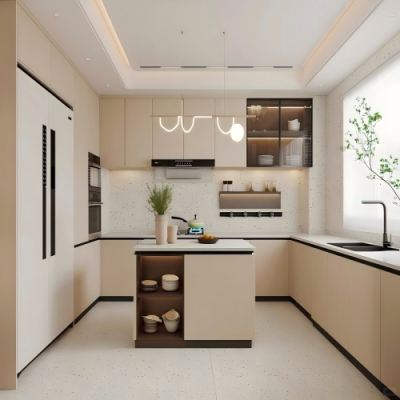
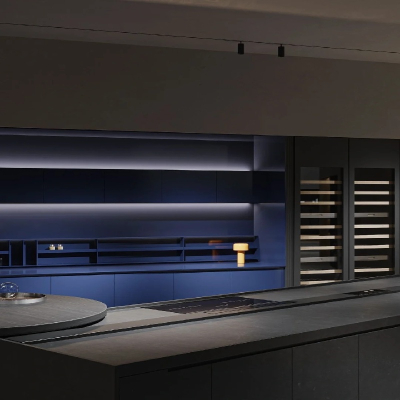
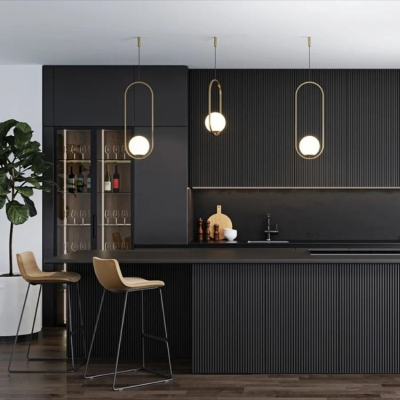
How to Choose Two-Tone Beige & Black Kitchen Cabinets
Discover how to choose modern two-tone beige and black kitchen cabinets. Explore global market trends, technical specifications, and B2B sourcing tips.
Introduction: The Evolution of Modern Kitchen Aesthetics
The contemporary residential interior market has witnessed a profound architectural shift over the past several years. Monochromatic white kitchens, which dominated home design for decades, are increasingly giving way to expressive, high-contrast color palettes that balance warmth and industrial sophistication. Among these emerging trends, the combination of warm beige and deep black has established itself as a premier choice for upscale residential developments and multi-family housing projects.
According to recent global interior design and construction market reports, demand for custom two-tone cabinetry has expanded at a compound annual growth rate exceeding 6.5%, driven by homeowners and property developers seeking distinct visual depth. Importers, distributors, and architectural contractors are actively sourcing high-performance solutions that satisfy this aesthetic shift without sacrificing structural integrity. Selecting the right configuration involves balancing visual harmony with material durability, manufacturing precision, and hardware quality.
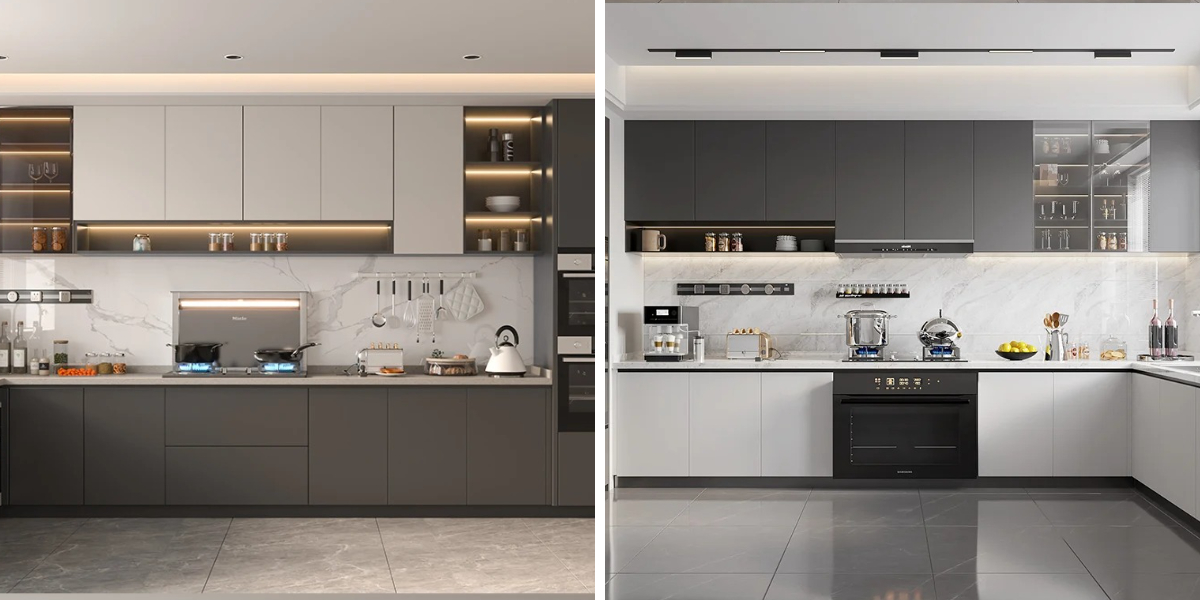
Global Market Trends and Buyer Preferences in Custom Cabinetry
International trade data reflects a surging preference for customized, dual-finish kitchen systems across North American, European, and Middle Eastern markets. B2B buyers and real estate developers frequently report that end-users are moving away from uniform color schemes in favor of zoned architectural features.
The Psychology of Beige and Black in Residential Architecture
The appeal of combining neutral beige with bold black lies in its inherent balance. Beige introduces organic warmth, light diffusion, and a welcoming ambiance, neutralizing the starkness often associated with minimalist architecture. Conversely, black introduces sharp focal points, grounding the spatial layout and adding a touch of luxury. When integrated into two tone kitchen cabinets, this dynamic duo allows designers to visually anchor heavy base structures while keeping upper elevations light and open.
Key Procurement Challenges for International Importers
Global B2B procurement managers face distinct challenges when sourcing these specialized products:
Finish Consistency: Ensuring uniform gloss or matte levels across different substrate batches.
Moisture Resistance: Protecting high-wear areas, particularly black lower cabinets prone to footprint visibility and scuffing.
Hardware Integration: Sourcing soft-close slides, concealed hinges, and integrated lighting systems that match European and American compliance standards.
Technical Specifications and Material Engineering
To meet rigorous international building and safety standards, high-end cabinetry requires meticulous material selection and advanced production engineering. When evaluating options for beige and black kitchen design, trade buyers must look closely at substrate composition, surface coatings, and edge-banding technology.
Substrate and Core Materials
1.Engineered Plywood / E0 MDF (Medium Density Fiberboard): Ideal for smooth, flawless lacquer finishes on flat-panel doors due to its uniform density and lack of natural grain telegraphing.
2.Moisture-Resistant Plywood Core: Frequently specified for base cabinets in humid or coastal environments to prevent warping and water absorption.
Surface Finishes and Coating Technology
The longevity of a two-tone kitchen heavily depends on the protective coating applied to the panels:
UV-Cured Lacquer Coatings: Provide superior scratch, stain, and chemical resistance compared to traditional liquid paints.
Anti-Fingerprint Matte Surfaces: Essential for black lower cabinets, utilizing nanotechnology to scatter light and repel oils from daily contact.
Laser Edge-Banding: Eliminates visible glue lines, creating a seamless, waterproof barrier around door perimeters that prevents moisture infiltration and delamination.
Structural Configurations and Manufacturing Workflows
Optimizing spatial architecture requires a thorough understanding of layout dynamics and automated manufacturing accuracy.
Structuring the Two-Tone Layout
A successful installation relies on strategic color placement. Industry standards typically dictate positioning lighter beige finishes on upper wall cabinets or tall pantry units to maximize perceived vertical space and reflect ambient light. Deployed on base cabinets and kitchen islands, black finishes establish a grounded visual weight that hides everyday scuffs while anchoring the room's central workstation.
CNC Precision and Automated Production
Modern B2B manufacturing relies heavily on computer-controlled automation to maintain strict dimensional tolerances:
CNC Nesting Systems: Ensure precise cutting of panels, custom sizing, and flawless pre-boring for hinges and drawer slides.
Automatic Board Washing and Edge Sealing: Protects against particulate contamination during the bonding phase, ensuring bond strengths that withstand rigorous international shipping and thermal shifts.
Key Considerations for B2B Importers and Project Developers
For wholesale buyers, real estate contractors, and kitchen showroom owners, selecting a manufacturing partner requires evaluating operational capabilities beyond simple unit pricing.
Quality Control and Compliance
Ensure your manufacturing partner adheres to international quality management certifications (such as ISO9001) and environmental standards (FSC or CARB). Rigorous pre-shipment inspections should verify door alignment, hinge cycle durability (minimum 50,000 cycles), and load-bearing capacities for drawer boxes.
Packaging and Logistics
Custom cabinetry is vulnerable to transit damage. Importers must verify that manufacturers utilize multi-layer corrugated export packaging, reinforced corner guards, and knockdown (KD) or rigid pre-assembled modular crating designed to withstand long ocean freight transits.
Frequently Asked Questions (FAQ)
Q: Can the dimensions and color ratios of beige and black cabinets be customized for specific real estate projects?
A: Yes. All manufacturing parameters, including cabinet heights, widths, depth modifications, and specific matte or gloss levels for the beige and black finishes, can be fully tailored to match architectural blueprints and project specifications.
Q: What are the best surface treatments to prevent fingerprints and scratches on black kitchen cabinets?
A: We utilize advanced anti-fingerprint nano-lacquer coatings and thermal-fused matte laminates that repel oils, resist micro-scratches, and maintain a pristine appearance even under heavy daily use.
Q: What is the typical production lead time and minimum order quantity (MOQ) for wholesale buyers?
A: Standard production lead times range from 25 to 35 days depending on project scale, backed by automated CNC lines that accommodate both container-load wholesale orders and mixed-item batch production.
Take the Next Step in Your Kitchen Sourcing
Ready to elevate your project portfolio with premium, high-margin cabinetry? Contact our expert engineering and sales team today to request comprehensive technical data sheets, custom color swatches, physical product samples, and tailored wholesale quotations for your upcoming developments.