Looking for a Source Factory? Unveiling the Full OEM/ODM Customization Process For High-End Modern Kitchen Cabinets
For international buyers, property developers, and kitchen studio owners, finding a reliable manufacturing partner for high-end modern kitchen cabinets is a critical yet challenging task. You’re not just buying a product—you’re entrusting your brand reputation, project timelines, and client satisfaction to a partner. In 2026’s competitive market, demand for high-end modern kitchen cabinets is booming, driven by global trends toward minimalist aesthetics, functional intelligence, and sustainable living.
Securing a source factory that can seamlessly turn your technical drawings into flawless, install-ready cabinets is the key to successful import business. This guide demystifies the professional OEM/ODM customization process, offering a clear roadmap for overseas purchasers to navigate the complexities of custom cabinet manufacturing—from initial concept to final delivery—ensuring your vision is executed with precision and efficiency.
The Strategic Value of a True Source Factory
In an era of heightened supply chain scrutiny, distinguishing between a trading company and a genuine kitchen cabinet manufacturer is essential. A true source factory delivers more than competitive pricing: it provides control, transparency, and technical expertise. By partnering directly with a facility that manages every step—from raw material processing to final assembly—you eliminate communication gaps and reduce quality deviation risks.
Modern procurement is all about risk mitigation. A professional factory operates with full transparency, allowing you to audit production capacity, quality control measures, and labor standards. This is especially critical for high-end modern kitchen cabinets, where tolerances are tight (often within 0.5mm) and finish quality must be impeccable. Understanding the manufacturing workflow helps you assess if a partner can handle complex projects—such as large-scale hotel fit-outs or luxury residential developments—without compromising customization.
Additionally, direct collaboration with a source factory fosters innovation. Beyond catalog selections, you gain access to R&D capabilities: whether integrating smart home tech into joinery or testing sustainable materials (e.g., high-density bamboo, recycled composites), a capable manufacturer acts as an extension of your design team.
Phase 1: Deep-Dive Consultation & Design Engineering
Creating high-end modern kitchen cabinets starts long before production—with a rigorous, detail-oriented consultation. For overseas buyers, this phase is often virtual but must be thorough, focusing on understanding both the “what” and “why” of your project.
Understanding Aesthetic & Functional Requirements
Modern design is diverse—from warm Japandi minimalism to stark urban industrial chic. Your manufacturing partner must demonstrate a nuanced grasp of these styles, with a focus on two key elements:
• Material Selection: High-end projects typically use moisture-resistant MDF, plywood, or stainless steel frames. The factory should provide clear data on formaldehyde emission standards (e.g., CARB P2, E0, ENF grade ≤0.025mg/m³) to ensure residential safety.
• Surface Finishes: The kitchen’s tactile appeal depends on its finish. Look for factories skilled in high-gloss lacquer (requiring dust-free spray booths), matte “skin-feel” PET film (fingerprint-resistant), or hand-sanded natural wood veneer—all hallmarks of premium modern design.
The Role of Advanced Design Software
In 2026, technology is central to the design phase. A competent source factory will use cutting-edge software to bridge concept and reality:
• 3D Visualization: Before production begins, you should receive photorealistic 3D renderings to visualize spatial relationships, lighting, and color harmony—ensuring alignment with your vision.
• Structural Engineering: Design concepts are converted into production-ready shop drawings, specifying joinery methods (dowel vs. tenon), hardware placement, and appliance clearance. This step is critical for OEM/ODM projects, where cabinets must fit perfectly into pre-existing architectural spaces.
Phase 2: Precision Manufacturing & Material Sourcing
Once the design is approved and the Bill of Materials (BOM) is finalized, production begins—where the source factory’s advantage shines. A vertically integrated facility controls every step from raw materials to finished cabinetry.
Raw Material Procurement & Inspection
Quality is built into the product from the start, beginning with raw material sourcing:
• Board Cutting: Sophisticated algorithms optimize cutting patterns to maximize material yield (reducing waste and cost). High-precision electronic saws ensure panels are cut to exact dimensions, with an error margin of <0.5mm—vital for seamless modern cabinet assembly.
• Edge Banding: Durability depends on quality edge banding, which seals raw core material to prevent moisture ingress. For high-end lines, look for laser edge banding or PUR (Polyurethane) gluing—creating a “zero-line” finish that’s invisible, heat-resistant, and humidity-resistant (key for modern kitchen environments).
CNC Machining & Drilling
CNC machining forms the “skeleton” of modern cabinets, with two critical steps:
• Hole Drilling: CNC drilling centers create precise holes for screws, dowels, and cam locks—aligning perfectly with custom hardware specs (e.g., Blum, Hettich) for OEM/ODM projects.
• Grooving & Profiling: 5-axis CNC machines mill unique profiles (e.g., handle-less push-to-open mechanisms, integrated LED channels)—enabling the complex geometries that define high-end modern design.
Surface Treatment & Finishing
The finish is often the deciding factor for buyers, requiring a controlled environment:
• Spray Booths: Painted finishes use automated spray lines or skilled manual sprayers in dust-free spaces, with multi-layer processes (primer, sanding, topcoat) for a deep, lustrous look.
• Curing: Strict drying schedules ensure finishes are hard, durable, and resistant to daily wear—rushing this step leads to soft, scratch-prone surfaces.
Phase 3: Quality Control & The “Dry Fit” Protocol
For overseas buyers unable to be on-site, quality control (QC) is the safety net—and it should be integrated into every production step.
In-Process Quality Control
• Dimensional Checks: Random samples are measured post-cutting/drilling to ensure alignment with shop drawings.
• Visual Inspection: Every panel is checked for surface defects (scratches, dents, color inconsistencies) before assembly.
The Pre-Shipment Dry Fit
A hallmark of premium manufacturers, the pre-shipment dry fit (trial assembly) simulates installation—verifying part alignment, door straightness, and drawer smoothness. This catches structural errors before shipping, and in 2026, factories often provide video evidence or digital reports for remote buyer sign-off—reducing costly on-site installation issues.
Hardware & Accessory Integration
• Functional Testing: Drawer runners are tested for load capacity and smoothness; hinges for opening angles and damping consistency.
• Smart Integration: Built-in charging stations, sensor lighting, or motorized lift systems are tested to meet destination market electrical standards (CE, UL, UKCA).
Phase 4: Professional Packaging & Logistics Solutions
Getting high-end modern kitchen cabinets to your warehouse or job site in perfect condition requires engineered packaging and logistics.
Export-Grade Packaging
• Layer 1: Foam/pearl wool wrapping protects finishes from scratches.
• Layer 2: Heavy-duty cardboard/plastic guards reinforce vulnerable corners/edges.
• Layer 3: Fumigated plywood crates or sturdy pallets prevent shifting during ocean transit and port handling.
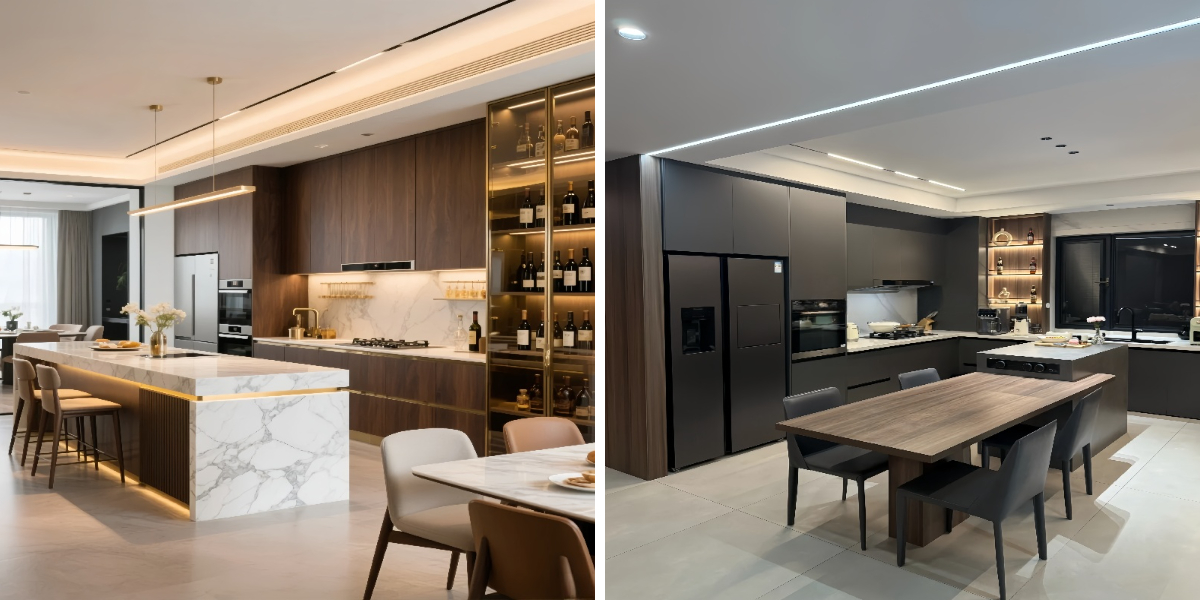
Conclusion: Building a Long-Term Partnership
Choosing a source factory for high-end modern kitchen cabinets is a strategic decision that shapes your business growth. It’s not just a transaction—it’s a partnership. By understanding the full OEM/ODM process—from design engineering to export packaging—you can ask the right questions and set clear expectations.
In 2026, the market rewards those who prioritize quality, transparency, and sustainability. A manufacturer invested in advanced machinery, rigorous QC, and clear communication is more than a supplier—they’re a catalyst for your success. As you navigate the global market, choose a partner that shares your commitment to excellence, ensuring every cabinet reflects your brand’s promise of quality.