Choosing Kitchen Cabinet Materials for High Humidity
Learn how to select durable kitchen cabinets for high-humidity environments. Expert guide for B2B buyers on moisture-resistant panels, hardware, and core substrates.
Introduction: The Hidden Challenge of Moisture in Commercial and Residential Casework
When outfitting residential developments, hospitality projects, or coastal multi-family properties, material selection dictates the long-term viability of interior casework. High-humidity environments—such as tropical coastal developments, luxury beachfront villas, and high-occupancy commercial kitchens—pose severe structural risks to standard wood products. Excessive moisture absorption causes swelling, delamination of edge banding, warping of door panels, and premature structural failure, ultimately leading to costly warranty claims and compromised client satisfaction.
For B2B procurement managers, real estate developers, and architectural specifiers, mitigating moisture damage requires a strategic understanding of core substrates, moisture-resistant edge sealing, and hardware resilience. This guide explores the engineering principles, material science, and technical criteria necessary for sourcing high-performance kitchen cabinets capable of withstanding extreme atmospheric moisture without sacrificing aesthetic sophistication.
Understanding the Vulnerabilities of Conventional Substrates
Standard residential casework frequently relies on low-density particle board or untreated fiberboard, which act like sponges when exposed to persistent relative humidity exceeding 70 percent. Water vapor penetrates microscopic voids within the core material, breaking down internal resin bonds.
The Mechanics of Moisture Absorption
When ambient moisture levels fluctuate, wood-based panels expand and contract. Without proper moisture barriers, water infiltration leads to dimensional instability. In kitchen settings, this is accelerated by steam from cooking appliances, ambient coastal salt air, and trapped moisture beneath sinks or countertops. Consequently, specifying specialized moisture-resistant substrates is a non-negotiable requirement for commercial and high-humidity residential casework.
High-Performance Core Substrates for Humid Climates
To guarantee structural longevity, manufacturers must utilize engineered wood panels engineered specifically to resist water ingress and internal degradation.
1. Moisture-Resistant MDF (MR-MDF)
Moisture-resistant Medium Density Fiberboard is manufactured using specialized melamine-urea-formaldehyde (MUF) resins that significantly reduce water absorption rates compared to standard MDF. MR-MDF features a dense, homogeneous internal structure that provides an exceptional surface for subsequent lacquering or high-gloss polymer laminates, preventing moisture from penetrating the core.
2. Exterior-Grade Plywood Substrates
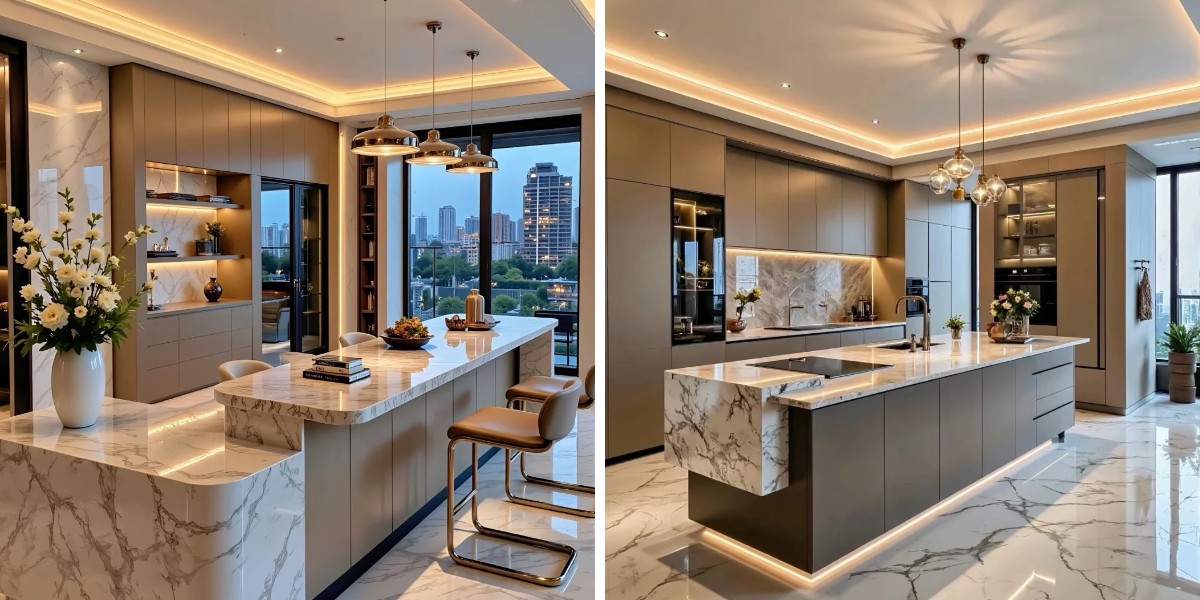
Plywood consists of cross-laminated wood veneers bonded with waterproof adhesives (such as Phenol-Formaldehyde resin). This cross-grain construction neutralizes natural wood movement and offers superior screw-holding strength in humid conditions. For premium modular kitchen cabinet installations in coastal zones, multi-layer plywood casework provides the ultimate baseline for structural integrity and load-bearing performance under wet loads.
Surface Finishes and Edge Banding: The First Line of Defense
Even the highest-grade core substrate will fail if moisture breaches the exterior surface or panel edges. Waterproofing the envelope of each cabinet component is vital.
Laser Edge Banding and PUR Adhesives
Traditional EVA hot-melt adhesives can soften under high heat and humidity, allowing moisture to seep into panel joints. Utilizing Polyurethane Reactive (PUR) adhesives creates an unbreakable, moisture-proof chemical bond between the PVC/ABS edge banding and the panel substrate. Furthermore, advanced laser edge-banding technology eliminates the visible glue line entirely, preventing vapor transmission points and ensuring seamless water resistance.
High-Performance Surface Laminates
PET and Acrylic Films: Provide a non-porous, highly sealed outer layer that repels water droplets and steam condensation.
Melamine and High-Pressure Laminate (HPL): Offer industrial-grade scratch and moisture resistance, ideal for heavy-use commercial rental properties.
Hardware Resilience in Saline and Humid Environments
Substrates and finishes represent only half of the equation; interior hardware must also endure corrosive, moisture-laden air. Rust and oxidation compromise soft-close mechanisms, drawer slides, and concealed hinges.
Specifying Marine-Grade Stainless Steel and Advanced Coatings
Grade 304 Stainless Steel: Essential for structural internal components, brackets, and base sink cabinets where direct water contact occurs. Grade 304 offers superior chromium-nickel content, providing robust defense against oxidation.
Electroplated and Salt-Spray Tested Hinges: Leading hardware suppliers—such as Blum and Tutti—subject their concealed hinges and drawer systems to rigorous neutral salt spray (NSS) testing exceeding 48 hours. Specifying certified corrosion-resistant hardware guarantees smooth, silent operation over decades of high-humidity exposure.
Precision Manufacturing and Pre-Assembly Quality Control
Engineering excellence must be matched by factory execution. Gaps in assembly create micro-channels for moisture accumulation.
Automated CNC Precision
Utilizing full-automatic CNC nesting machinery and six-sided drilling centers ensures absolute squareness and tight dimensional tolerances. When panels fit together with absolute precision, joint sealants and gaskets form an airtight, moisture-resistant envelope across the entire modular assembly.
Strict 5S Factory Management
A controlled manufacturing environment prevents raw materials from absorbing ambient shop moisture prior to packaging. Implementing strict 5S quality standards ensures that every batch of custom kitchen cabinets dispatched for overseas export meets rigorous international environmental compliance, such as ENF and E0 low-emission certifications.
Frequently Asked Questions (FAQ)
What makes plywood superior to standard particle board in high-humidity kitchens?
Plywood utilizes cross-laminated veneer construction bonded with waterproof adhesives, offering superior dimensional stability, structural rigidity, and resistance to water-induced swelling compared to standard particle board.
How do edge-banding techniques prevent moisture damage in tropical climates?
Advanced manufacturing applies PUR adhesives and laser edge-banding technology to create a seamless, waterproof barrier around panel edges, preventing steam and ambient humidity from penetrating the internal wood substrate.
Are hardware components protected against coastal salt-air corrosion?
Yes. High-end casework specifies Grade 304 stainless steel components and rigorously salt-spray tested hinges and drawer slides from trusted brands like Blum and Tutti to prevent oxidation in saline environments.
What environmental and emission standards do your moisture-resistant cabinets meet?
All our moisture-resistant engineered wood substrates strictly comply with international E0 and ENF environmental standards, ensuring low formaldehyde emissions alongside high structural durability.
Secure Your Project Success with Expert Casework Solutions
Outfitting high-humidity residential or commercial developments requires reliable manufacturing partnerships, precision engineering, and uncompromising material standards. Whether you are developing coastal villas, luxury multi-family apartments, or hospitality complexes, our factory delivers tailored casework designed for extreme environments.
Contact our export sales team today to request comprehensive technical data sheets, material sample kits, or a customized project quotation.