Master Bedroom Storage Innovations 2026: Design Strategies
Explore comprehensive 2026 master bedroom storage innovations, market data, custom wardrobe trends, and manufacturing parameters for global B2B buyers.
Master Bedroom Storage Innovations 2026: Design Strategies for Modern Homes
The international residential furniture, architectural millwork, and custom interior storage sector is currently undergoing a profound structural evolution as real estate developers, architectural designers, and urban planners adapt to modern micro-living demands and luxury urban expansion. Market analytics indicate that the global bedroom furniture and built-in storage market is valued at approximately USD 307.66 billion in 2026 and is projected to expand toward USD 512.94 billion by 2034, registering a steady compound annual growth rate (CAGR) of 6.60%. Within this macro sector, custom wardrobe and integrated storage systems account for nearly 28% of total market revenue, driven by a surge in high-density residential developments, multi-family housing projects, and an increased consumer emphasis on personalized household organization. For international B2B importers, property developers, and wholesale distributors, aligning product portfolios with contemporary storage innovations is vital for maintaining a competitive edge in an increasingly crowded marketplace.
Global Market Dynamics and Urbanization Drivers
Rapid worldwide urbanization, shifting demographic profiles, and an expanding global middle class continue to reshape residential architecture across major metropolitan centers. As urban floor plans become more compact due to soaring real estate costs, the traditional master bedroom has transitioned from a basic sleeping quarters into a multifunctional sanctuary requiring highly efficient space utilization.
Regional Growth Patterns and Procurement Shifts
Asia-Pacific Production Leadership: Asia-Pacific remains the primary manufacturing and consumption core, accounting for over 41% of global market volume, driven by robust local housing completions and advanced factory infrastructure.
North American Renovation Demand: North American markets show that over 64% of homeowners prioritize master bedroom remodeling and storage upgrades as key interior investment projects.
European Minimalist Specifications: European real estate sectors heavily favor modular, sustainable built-in storage configurations that comply with strict green building standards.
Middle Eastern Luxury Real Estate: Rapidly expanding high-end villa and apartment complexes across the Middle East demand bespoke, oversized wardrobe installations featuring premium finishes and integrated lighting.
Emerging Interior Design Trends and Customization Shifts
Modern interior design trends prioritize visual continuity, clean architectural lines, and tailored spatial layouts over bulky, standalone furniture pieces. Property buyers increasingly look for built-in storage solutions that blend seamlessly into room walls while offering expansive interior capacity.
Premiumization and Aesthetic Integration
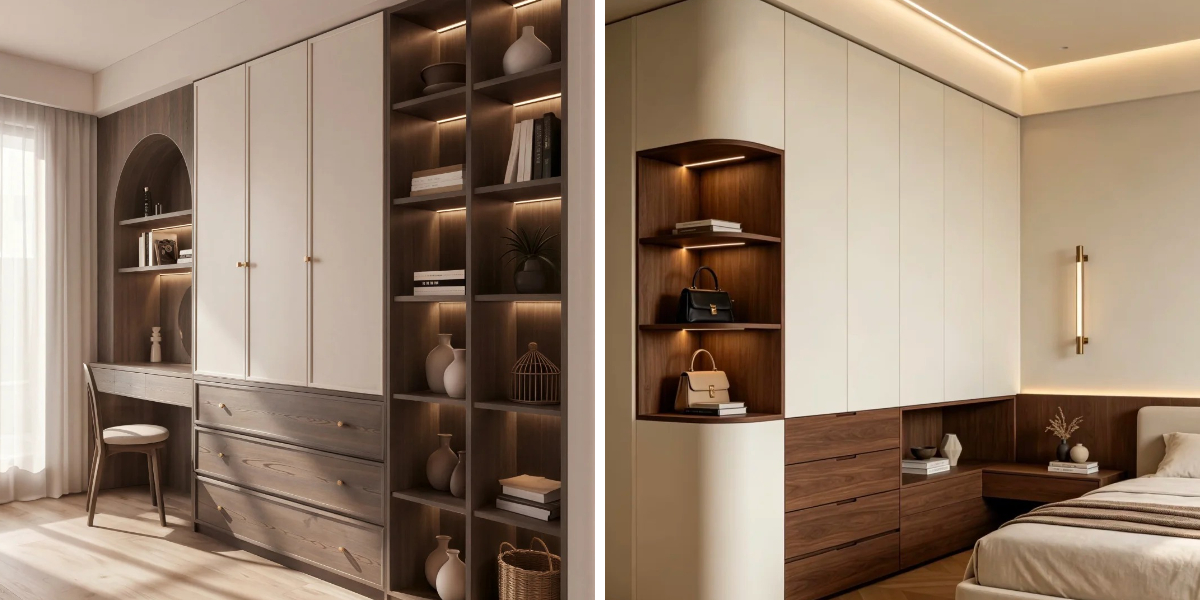
Storage furniture is no longer regarded as a mere utility; it is now evaluated as a core architectural element of interior design. Clean, flat-panel facades combined with neutral matte textures, warm wood grains, and integrated ambient LED strip lighting define the contemporary master bedroom aesthetic. This design strategy maximizes the perceived floor space of smaller rooms while creating a luxurious, hotel-like atmosphere. Furthermore, the integration of custom internal organizers allows users to tailor their storage layouts precisely to their lifestyle needs, transforming daily routines into seamless, organized experiences.
Technical Parameters, Product Structure, and Manufacturing Excellence
To satisfy rigorous commercial and residential performance criteria, export-grade storage installations rely on advanced engineering, high-density substrates, and precise mechanical components.
Precision Engineering and Structural Integrity
Modern closet and wardrobe manufacturing utilizes automated Computer Numerical Control (CNC) machinery to cut and bore panels with absolute dimensional accuracy. Automated thermal edge-banding applies moisture-resistant PUR adhesives, securing tight structural joints and preventing panel warping in fluctuating climatic conditions.
Material Specifications and Hardware Quality
High-Density Core Boards: Utilization of premium engineered wood and low-emission CARB Phase 2 compliant substrates ensures long-term structural load-bearing capacity.
Track and Roller Systems: Heavy-duty top-hung and bottom-rolling aluminum hardware ensure effortless, silent operation across thousands of continuous opening cycles.
Modular Internal Frameworks: Interchangeable shelving, multi-tiered hanging rods, and soft-close drawer inserts provide ultimate layout flexibility for end-users.
Surface Protection Coatings: Application of anti-fingerprint and scratch-resistant nano-coatings ensures that deep finishes remain pristine over years of intensive daily use.
International Buyer Procurement Preferences and Supply Chain Pain Points
Global B2B procurement managers frequently encounter operational bottlenecks when sourcing large-scale architectural cabinetry across borders. Key challenges include dimensional inconsistency, high shipping volumes, and inadequate transit protection.
Mitigating Sourcing Risks through Factory Partnerships
Successful international buyers partner directly with integrated manufacturers capable of providing comprehensive shop drawings, modular flat-pack packaging to minimize ocean freight costs, and rigorous pre-assembly quality inspections. Ensuring strict adherence to international environmental and safety certifications further safeguards developers against compliance failures. Direct factory communication channels also allow for rapid prototyping and custom dimension adjustments tailored to specific project blueprints, effectively minimizing on-site installation delays and labor costs.
Frequently Asked Questions (FAQ)
Q1: What factors are driving the growth of the master bedroom storage market in 2026?
A: Growth is primarily propelled by accelerated global urbanization, an increase in residential renovation projects, and rising consumer demand for space-efficient, customized storage solutions in compact modern apartments.
Q2: How do advanced manufacturing techniques improve wardrobe durability?
A: Utilizing automated CNC machining and precision edge-banding eliminates human error, guaranteeing exact panel alignment, tight structural joints, and superior resistance against moisture and everyday wear.
Q3: What environmental standards should commercial importers verify for wood cabinetry?
A: Importers should look for low-emission certifications such as ENF or E0 formaldehyde ratings, alongside sustainable forestry verifications like FSC, to comply with global green building regulations.
Q4: How can my business request custom product samples and commercial quotations?
A: We invite global developers, contractors, and wholesale distributors to connect directly with our engineering and export sales teams. Contact us today to review our technical specifications, discuss your project requirements, and request tailored samples and quotations.