Why Modern Custom White Kitchen Cabinets Transform Homes
Explore how modern custom white kitchen cabinets redefine contemporary living with superior spatial planning, sustainable materials, and timeless design.
Global Industry Background and Market Dynamics
The global architectural interiors and residential fit-out sectors are currently undergoing a structural transformation, driven by shifting homeowner expectations and a heightened focus on spatial efficiency. According to recent macroeconomic evaluations of the residential construction market, the global kitchen cabinetry sector is expanding steadily, propelled by a compounding annual growth rate (CAGR) that underscores robust long-term investment. Within this macro environment, interior designers, real estate developers, and international B2B procurement specialists are increasingly prioritizing flexible, high-utility building materials.
Urbanization trends across North America, Europe, and the Asia-Pacific region have fundamentally changed spatial layouts. As contemporary floor plans favor open-concept living, the kitchen has evolved from a purely utilitarian cooking workspace into the visual and social core of the modern residence. Consequently, global demand has shifted away from rigid mass-produced alternatives toward highly adaptable, premium architectural solutions.
Market Data and Consumer Preference Shifts
Recent market research reports indicate that the valuation of the global kitchen storage sector exceeds one hundred billion dollars, with customized and semi-customized cabinetry segments capturing significant market share growth. End-users and property developers are no longer satisfied with generic, off-the-shelf configurations that fail to optimize awkward floor plans or architectural irregularities.
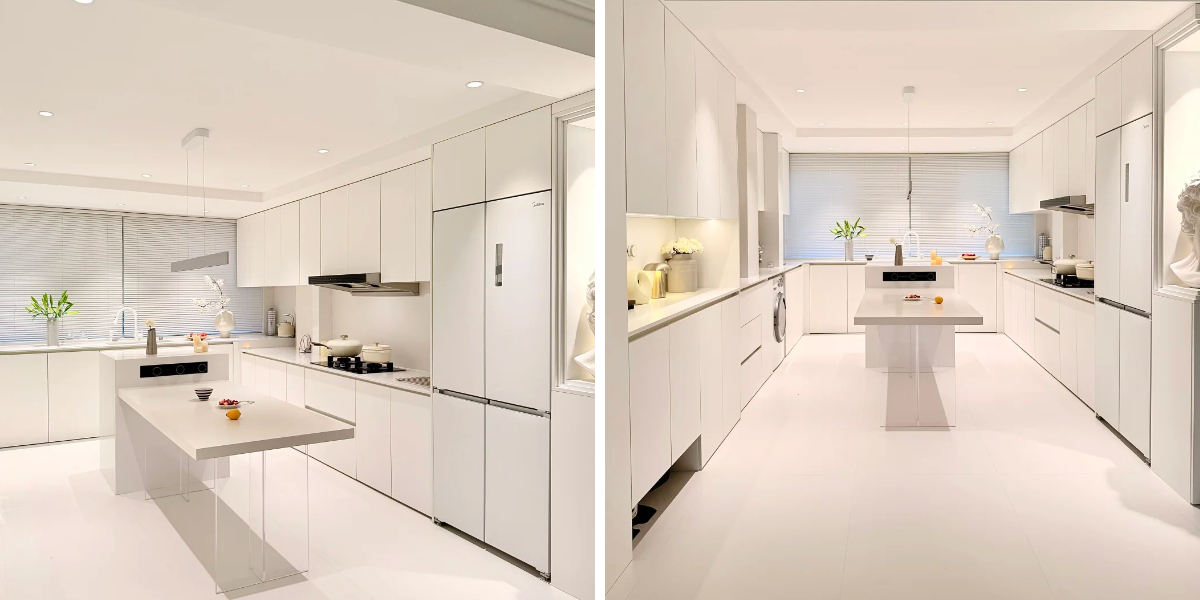
Statistical data compiled across key real estate hubs reveals that approximately sixty percent of homeowners undertaking comprehensive residential refurbishments prioritize kitchen upgrades as their primary investment. Among various aesthetic directions, modern custom white kitchen cabinets have emerged as an undisputed market leader. This preference is rooted in white's psychological association with cleanliness, spatial expansion, and optical brightness—qualities that are paramount as urban living spaces become more compact. Furthermore, B2B distributors report that commercial housing projects featuring custom white cabinetry achieve higher resale valuations and faster absorption rates in competitive real estate markets.
Trend Analysis: Minimalism, Light, and Spatial Efficiency
The enduring popularity of white cabinetry is deeply intertwined with broader architectural movements favoring minimalism and biophilic design principles. Contemporary interior design emphasizes clutter-free environments, maximum natural light penetration, and seamless visual transitions between rooms.
By reflecting natural and artificial light sources, white kitchen cabinet design inherently amplifies the perceived volume of a room, making even modest apartments feel expansive and airy. Designers utilize low-saturation matte finishes, slab doors, and integrated handleless mechanisms to minimize visual noise. This design discipline ensures that cabinetry acts as an architectural canvas rather than an overpowering focal point, allowing homeowners to personalize their spaces with shifting accent colors, metallic hardware trims, and textural stone countertops.
Technical Parameters and Advanced Manufacturing Specifications
To meet stringent international building standards and export compliance requirements, the production of professional-grade cabinetry demands rigorous engineering protocols. Export-oriented manufacturers utilize advanced automated machinery, including computer numerical control (CNC) nesting systems and edge-banding technology, to achieve micro-level precision.
Core Structural Substrates
Moisture-Resistant Plywood and Engineered Wood: High-density multi-layer boards treated with low-emission bonding agents are deployed to resist warping, swelling, and moisture degradation in humid kitchen environments.
Formaldehyde-Free Compliance: Substrates strictly conform to international CARB Phase 2 and E0 emission standards, ensuring safe indoor air quality for residential and commercial developments.
Precision Surface Finishes: Multi-layer UV-cured lacquers, durable thermofoil membranes, or high-pressure laminates (HPL) provide exceptional scratch, stain, and yellowing resistance over extended lifecycles.
Hardware Integration and Motion Technologies
Performance longevity relies heavily on heavy-duty, certified hardware components. Standard specifications incorporate soft-close under-mount drawer slides and concealed clip-on hinges tested for tens of thousands of continuous operation cycles. Push-to-open latches and 45-degree beveled edges facilitate sophisticated handleless executions without compromising tactile smoothness or structural integrity.
Customization Versus Stock Cabinets: The Strategic Advantage
When evaluating procurement options for large-scale real estate projects or bespoke residential installations, understanding the structural differences between custom and stock cabinetry is critical for project managers.
Precise Spatial Optimization: Stock or ready-made cabinets are manufactured in fixed increments, often resulting in unutilized filler gaps, unsightly dust traps, and compromised storage capacities. Conversely, custom kitchen cabinets are engineered to the exact millimeter of architectural blueprints, utilizing every square inch effectively.
Aesthetic and Material Control: Custom fabrication grants architects absolute freedom to select specific door profiles, internal accessories, and exact paint or veneer color matching, whereas stock selections limit choices to a restricted catalog.
Long-Term Durability: Custom manufacturing processes generally employ superior joinery techniques, thicker core boards, and higher-grade hardware assemblies, translating to lower maintenance overhead and extended warranty protection for commercial property developers.
International B2B Procurement Considerations and Buyer Pain Points
Navigating cross-border procurement for architectural millwork presents distinct challenges for global buyers, including supply chain volatility, dimensional accuracy risks, and regulatory compliance hurdles. Overseas importers frequently encounter issues related to poor packaging that leads to transit damage, inconsistent batch finishes, and complex installation procedures on-site.
To mitigate these supply chain friction points, top-tier manufacturing partners implement rigorous quality assurance workflows. Flat-pack and fully assembled modular solutions are engineered with clear labeling, pre-drilled assembly dowels, and comprehensive technical documentation to streamline installation for local contractors. Furthermore, strict adherence to export crating standards ensures that fragile components, such as glass inserts and high-gloss panels, arrive at international job sites in pristine condition.
Frequently Asked Questions (FAQ)
What is the typical minimum order quantity (MOQ) for custom white kitchen cabinets in wholesale orders?
MOQ requirements vary depending on the scale of the project and customization complexity. Generally, for direct factory-direct B2B orders, manufacturing minimums are structured around container loads (such as a 20GP or 40HQ) or specific residential project phases. However, flexible trial orders and sample sets can be arranged for evaluation purposes.
How are cabinets packaged for international shipping to prevent transit damage?
Export-grade packaging utilizes multi-layer protection systems. This typically includes reinforced corrugated cardboard boxes, internal EPE foam corner guards, protective pearl-cotton wrapping for finished panels, and heavy-duty wooden crates or palletized banding for ocean freight security.
What are the standard lead times for manufacturing and shipping custom cabinet orders?
Standard production lead times range from twenty-five to thirty-five days following shop drawing approval and deposit receipt. Total delivery timelines depend on ocean freight transit schedules and destination port customs clearance procedures.
Can custom cabinet layouts accommodate non-standard architectural dimensions or irregular wall angles?
Yes. Custom manufacturing is specifically designed to handle non-standard dimensions, custom heights, angled corner configurations, and custom filler integration based on detailed site measurements provided by the architect or contractor.
Request Quotations, Technical Data & Samples
Are you an architectural designer, real estate developer, or global importer seeking high-performance cabinetry solutions for your next project? Contact our engineering and sales team today to access comprehensive technical specification sheets, CAD drawing templates, material swatches, and tailored wholesale quotations designed to elevate your project margins.